
Home > Industry Information > Fiber Optic Connector:Everything You Should To Know
This article provides a systematic exploration of fiber optic connectors, a critical component in modern optical communication systems. It begins with a clear definition of fiber optic connectors and an analysis of their irreplaceable role in enabling efficient light signal transmission. Subsequently, it categorizes common types of fiber optic connectors, detailing their structural features, performance characteristics, and typical use cases. The article then expands on the main application fields of these connectors, covering sectors such as telecommunications, industrial automation, healthcare, and transportation. Finally, a summary synthesizes the key information, highlighting the significance of fiber optic connectors in supporting high-speed, reliable, and large-capacity data transmission across diverse industries, as well as their adaptability to evolving technological demands.
2.1What is a fiber optic connector
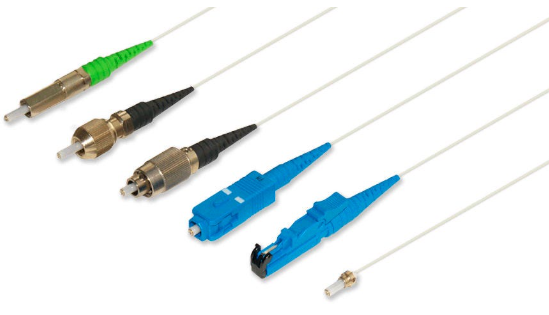
A fiber optic connector is a passive optical component designed to establish detachable, low-loss connections between two optical fibers or between an optical fiber and an optical device (e.g., optical transceivers, switches, or sensors). Its core structure typically includes three key parts: a ferrule, an adapter (also known as a flange), and a housing. The ferrule—usually made of ceramic, metal, or high-performance plastic—serves as the core component, precisely holding the optical fiber’s core to ensure accurate alignment when two connectors are mated. The adapter acts as an intermediary, facilitating the precise coupling of two ferrules to minimize signal loss. The housing, meanwhile, provides mechanical protection, dust resistance, and structural stability; some advanced designs also incorporate anti-misinsertion features and electromagnetic interference (EMI) shielding. Unlike traditional copper connectors (e.g., RJ45), fiber optic connectors transmit light signals rather than electrical signals, enabling them to achieve higher bandwidth, lower signal attenuation, and stronger anti-interference capabilities, making them suitable for both short-range and long-range optical communication scenarios.
2.2the importance of fiber optic connector
Fiber optic connectors play a pivotal role in optical communication systems, and their importance can be summarized in three key aspects:
First, they ensure efficient signal transmission. By minimizing insertion loss (typically ≤0.5dB for high-quality connectors) and return loss (often ≤-40dB), they prevent excessive attenuation or reflection of light signals, which is essential for maintaining the integrity of high-speed, long-distance data transmission—such as in 5G backhaul networks or inter-data-center links.
Second, they enable flexible and scalable system design. As detachable components, fiber optic connectors allow for easy installation, maintenance, and upgrades of optical networks. For example, in data centers, technicians can quickly replace faulty optical modules or expand network capacity by reconfiguring connector connections, without the need to rewire entire fiber links.
Third, they support the evolution of high-performance technologies. With the rapid growth of bandwidth-intensive applications (e.g., 4K/8K video streaming, cloud computing, and the Internet of Things), fiber optic connectors have adapted to meet higher standards—such as smaller form factors for dense packaging, multi-fiber designs for increased capacity, and ruggedized features for harsh environments. Without reliable fiber optic connectors, the full potential of high-speed optical communication technologies cannot be realized.
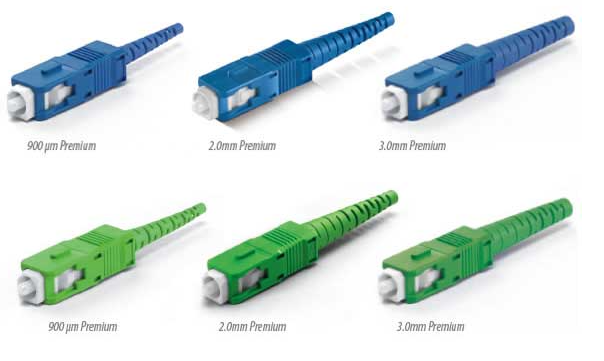
3.1 SC Connector (Subscriber Connector)
Structure:Features a rectangular housing and a push-pull latching mechanism, eliminating the need for twisting during insertion or removal. The ferrule is typically made of ceramic, ensuring high alignment precision.
Performance:Offers low insertion loss (≤0.2dB) and excellent repeatability. It is resistant to contamination, thanks to its dust-proof design, and has moderate cost.
Typical Use Cases:Widely used in telecommunications networks (e.g., 5G base stations), campus area networks (CANs), and cable television systems, especially for single-mode fiber connections.
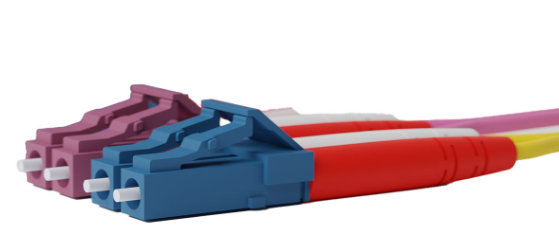
3.2 LC Connector (Lucent Connector)
Structure:A miniaturized connector, approximately half the size of an SC connector, with a push-pull latching system. It uses a small ceramic ferrule (1.25mm diameter) to save space on PCBs or equipment panels.
Performance:Boasts high density (allowing more connectors per unit area), low insertion loss (≤0.15dB), and lightweight design. It is compatible with high-speed optical transceivers (e.g.,SFP, SFP+, QSFP).
Typical Use Cases:Dominant in data centers for high-speed links (10G/25G/100G Ethernet), as well as in consumer electronics (e.g., high-end routers) and compact industrial devices.
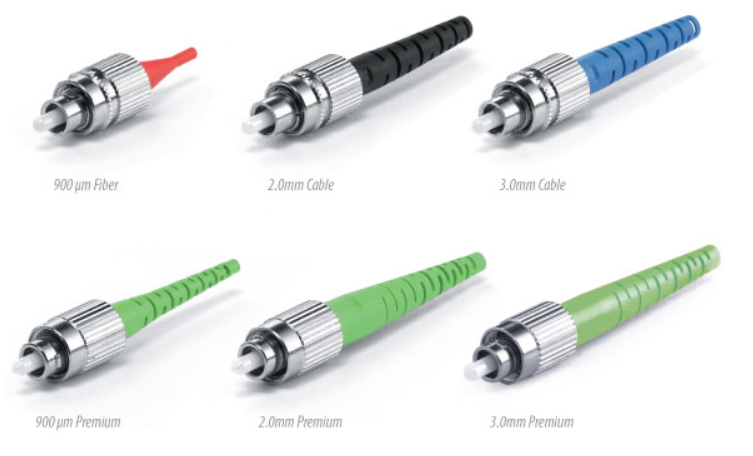
3.3 FC Connector (Ferrule Connector)
Structure:Has a cylindrical housing with a threaded locking mechanism, which provides strong vibration resistance. The ferrule is often made of metal, ensuring superior mechanical stability.
Performance:Delivers extremely low return loss (≤-40dB) and high connection reliability, making it ideal for scenarios requiring strict signal integrity. However, its threaded design slows down insertion and removal.
Typical Use Cases:Used in high-precision applications such as long-haul telecommunications backbones, satellite communication systems, and test and measurement equipment.
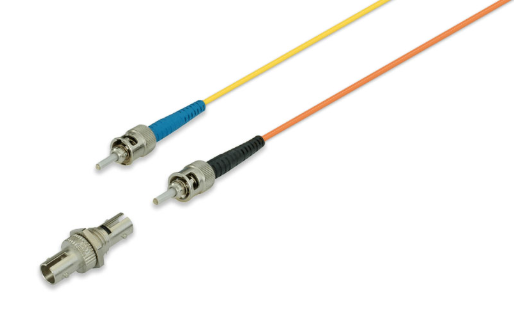
3.4 ST Connector (Straight Tip)
Structure:Features a round housing with a bayonet-style locking mechanism for quick mating. Early versions used metal ferrules, but modern variants often adopt ceramic ferrules for better performance.
Performance:Simple in structure, low in cost, and easy to operate. However, its alignment precision is slightly lower than that of SC/LC connectors, leading to higher insertion loss (≤0.3dB).
Typical Use Cases:Once widely used in local area networks (LANs) and industrial control systems, but now gradually replaced by smaller, higher-performance connectors (e.g., LC) in most modern applications.
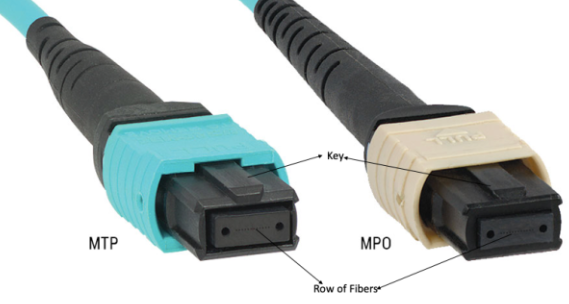
3.5 MPO Connector (Multi-fiber Push-On)
Structure:An integrated connector that can house 4,8,12,or24 optical fibers in a single ferrule. It uses a push-pull latching system for fast, high-density connections.
Performance:Enables simultaneous transmission of multiple light signals, significantly increasing bandwidth and reducing cabling complexity. It supports ultra-high-speed protocols (e.g., 400G/800G Ethernet).
Typical Use Cases:Critical in data centers for high-capacity links (e.g., between core switches and server racks), as well as in long-haul dense wavelength division multiplexing (DWDM) systems.
Telecommunications and Data Communications:This is the largest application field for fiber optic connectors. In telecommunications, SC and FC connectors are used in 5G base stations, backbone networks, and fiber-to-the-home (FTTH) systems to enable long-distance, high-speed data transmission. In data centers, LC and MPO connectors dominate: LC connectors support 10G–100G links between servers and switches, while MPO connectors handle 400G–800G ultra-high-speed inter-rack connections, meeting the bandwidth demands of cloud computing and big data processing.
Industrial Automation and Internet of Things (IIoT):Fiber optic connectors are essential for industrial environments with harsh conditions (e.g., high vibration, extreme temperatures, and strong electromagnetic interference). Ruggedized SC or LC connectors (with IP67/IP68 protection ratings) are used to connect optical sensors, programmable logic controllers (PLCs), and industrial robots, ensuring stable transmission of control signals and sensor data. For example, in automotive manufacturing lines, these connectors enable real-time communication between robots and central control systems, improving production efficiency and accuracy.
Healthcare and Medical Equipment:In the medical field, fiber optic connectors are valued for their anti-interference capabilities and biocompatibility. They are used in high-precision medical devices such as magnetic resonance imaging (MRI) machines, computed tomography (CT) scanners, and endoscopes. Ceramic-ferrule SC or LC connectors transmit high-resolution medical images without being affected by electromagnetic fields (which can distort electrical signals), ensuring accurate diagnosis. Additionally, in telemedicine, low-loss fiber connectors support real-time transmission of surgical videos and patient data, enabling remote consultation and guidance.
Aerospace and Defense:Aerospace and defense applications require fiber optic connectors with exceptional durability and reliability. Ruggedized FC or specialized military-grade connectors are used in aircraft communication systems, satellite payloads, and radar systems. These connectors can withstand extreme temperatures (-65°C to 150°C), high vibration, and radiation, ensuring uninterrupted signal transmission in critical missions—such as in fighter jets for real-time data sharing or in satellites for Earth observation data downlink.
Energy and Transportation:In the energy sector, fiber optic connectors are used in smart grids and renewable energy systems. For instance, in high-voltage substations, FC connectors connect optical current transformers and monitoring devices, transmitting grid status data over long distances without electromagnetic interference. In transportation, LC and SC connectors are integrated into high-speed rail and subway communication systems: they enable transmission of passenger WiFi signals, train control data, and security monitoring videos, ensuring safe and comfortable travel.
Fiber optic connectors are indispensable components in modern optical communication systems, serving as the "bridge" for efficient light signal transmission. This article has clarified their definition—passive components that enable detachable, low-loss connections between fibers or fiber devices—and emphasized their importance in ensuring signal integrity, enabling flexible network design, and supporting technological evolution.The classification of fiber optic connectors (SC, LC, FC, ST, MPO) reveals their diverse adaptability: from the miniaturized LC connectors for data centers to the multi-fiber MPO connectors for ultra-high-speed links, each type addresses specific needs of different scenarios. Their application fields, spanning telecommunications, industry, healthcare, aerospace, and energy, highlight their role in driving innovation across industries—whether enabling 5G networks, supporting smart manufacturing, or enhancing medical diagnosis.
Industry Information