
Home > Industry Information > PCM Audio Vs Dolby Digital
Audio technology plays a pivotal role in shaping the quality of our multimedia experiences, from movie nights at home to music streaming and gaming. Among the most prominent audio formats are PCM (Pulse-Code Modulation) and Dolby Digital, each with distinct characteristics, applications, and performance traits. This article provides a detailed overview of both formats, compares their core differences and similarities, analyzes their respective advantages and disadvantages, explores their typical application areas, and offers insights into choosing the right format for specific needs, culminating in a concise summary of key takeaways.[In a previous article, we compared PCM (Pulse code modulation) versus S/PDIF (Sony/Philips Digital Interface)]
PCM (Pulse-Code Modulation) is a fundamental, uncompressed digital audio format that serves as the backbone of most digital audio systems. It works by sampling an analog audio signal at regular intervals, quantizing each sample into a binary code, and storing or transmitting these binary values directly. As an uncompressed format, PCM preserves the full detail of the original audio signal without any data reduction. It is the standard format for audio CDs, digital audio workstations (DAWs), and the internal processing of most audio devices, supporting various bit depths (e.g., 16-bit, 24-bit) and sampling rates (e.g., 44.1 kHz, 48 kHz, 96 kHz) to accommodate different quality requirements.

2.2What is Dolby Digital
Dolby Digital, developed by Dolby Laboratories, is a popular lossy compressed surround sound audio format. Originally known as AC-3, it is designed to reduce audio file size or bandwidth requirements while maintaining acceptable sound quality. Dolby Digital achieves compression by eliminating redundant or perceptually irrelevant audio data—sounds that the human ear is less likely to detect. It is most commonly associated with 5.1 surround sound systems, which include five full-range channels (front left, front right, center, rear left, rear right) and one low-frequency effects (LFE) channel for bass. However, it also supports other channel configurations, from mono to 7.1 surround sound. Dolby Digital is widely used in Blu-rays, DVDs, streaming services, and broadcast television.
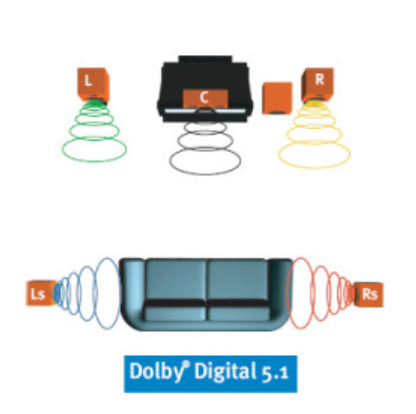
2.3Core differences
Aspect | PCM Audio | Dolby Digital |
Compression Type | Uncompressed | Lossy compressed |
Data Size/Bandwidth | Large; depends on bit depth and sampling rate | Smaller; significantly reduced via compression |
Channel Support | Typically stereo (2-channel) or multi-channel (up to 32 channels in high-end systems) | Primarily 5.1 surround sound (supports up to 7.1) |
Signal Integrity | Preserves 100% of original audio data | Loses non-perceptual data during compression |
Encoding/Decoding | No encoding needed (direct digitization); decoding is simple | Requires encoding (compression) and decoding (via Dolby-certified hardware/software) |
Origination | Originates from analog-to-digital conversion of audio signals | Derived from PCM audio via compression |
2.4Same and Different
Similarities
Digital Nature:Both PCM and Dolby Digital are digital audio formats, meaning they represent audio as binary data, enabling consistent reproduction across compatible devices.
Compatibility:Both are widely supported by modern audio equipment, including speakers, receivers, TVs, and media players.
Foundation Relationship:Dolby Digital is built on PCM audio—compression algorithms process PCM data to create Dolby Digital streams, which are then decoded back to PCM for playback.
Quality Focus:Both aim to deliver high-quality audio experiences, though they pursue this goal through different technical approaches.
Differences
As highlighted in the "Core Differences" table,the primary distinctions lie in compression (uncompressed vs. lossy), data efficiency (large vs. compact), channel specialization (versatile vs. surround-focused), signal integrity (lossless vs. lossy), and processing requirements (minimal vs. encoding/decoding needed). Additionally, PCM is a "raw" digital format, while Dolby Digital is a "processed" format optimized for storage and transmission.
3.1PCM audio advantage and disadvantage
Advantages
Superior Audio Quality:Since PCM is uncompressed, it retains every detail of the original analog audio signal, delivering transparent, high-fidelity sound ideal for music and critical listening.
Simplicity:No complex encoding or decoding is required, reducing latency and potential processing errors.This makes it ideal for real-time applications like live music.
Versatility:Supports a wide range of bit depths and sampling rates, from standard CD quality (16-bit/44.1 kHz) to high-resolution audio (24-bit/96 kHz or higher).
Universality:It is the native format for most audio hardware (e.g., DACs, sound cards) and software, ensuring broad compatibility without proprietary dependencies.
Disadvantages
Large File Sizes:Uncompressed data results in much larger files—for example, a 3-minute 16-bit/44.1 kHz stereo PCM track is ~30 MB, compared to ~3-5 MB for a Dolby Digital track of similar length.
High Bandwidth Demand:Transmitting PCM (especially multi-channel or high-resolution) requires significant bandwidth, making it impractical for streaming services or broadcast TV with limited bandwidth.
Storage Inefficiency:Storing large libraries of PCM audio (e.g., high-resolution music collections) requires substantial storage space, which can be costly.
3.2Dolby Digital advantage and disadvantage
Advantages
Efficient Data Compression:Lossy compression drastically reduces file size and bandwidth needs, making it ideal for streaming, broadcasting, and physical media (e.g., DVDs, Blu-rays) where storage/bandwidth is limited.
Surround Sound Expertise:Optimized for 5.1 surround sound, it delivers immersive spatial audio experiences that enhance movies, TV shows, and games.
Broad Ecosystem Support:Supported by nearly all home theater systems,TVs, streaming platforms (e.g.,Netflix, Amazon Prime Video),and gaming consoles, ensuring seamless integration.
Balanced Quality:While lossy, its compression algorithms are designed to preserve perceptible audio quality,making the difference from PCM indistinguishable to most listeners in typical home environments.
Disadvantages
Loss of Audio Data:Compression removes non-perceptual audio information, which can result in subtle degradation (e.g.,reduced dynamic range, loss of fine detail) that audiophiles may notice.
Dependence on Decoding:Requires Dolby-certified hardware or software to decode, adding a layer of complexity and potential compatibility issues with older or non-certified devices.
Limited High-Resolution Support:Dolby Digital’s standard format is capped at 48 kHz sampling rate and 16-bit depth, making it less suitable for high-resolution audio applications.
Latency Potential:Encoding and decoding processes can introduce small latency, which may be noticeable in real-time applications like gaming if not properly optimized.
4.1PCM Audio Application Areas
Music Production & Distribution:Used in recording studios (DAWs), high-resolution music streaming (e.g.,Tidal Masters, Qobuz), and physical media like audio CDs and SACDs (Super Audio CDs).
Hi-Fi Audio Systems:Preferred by audiophiles for home stereo setups, where uncompressed quality and transparency are prioritized over file size.
Professional Audio:Utilized in live sound reinforcement, audio editing, and mastering, where low latency and signal integrity are critical.
Internal Device Processing:Serves as the native format for DACs (Digital-to-Analog Converters), sound cards, and headphone amplifiers, as it requires no decoding.
4.2Dolby Digital Application Areas
Home Theater Systems:The standard format for DVDs, Blu-rays, and 4K UHD discs, delivering 5.1/7.1 surround sound for movies and TV shows.
Streaming&Broadcasting:Used by major streaming platforms (Netflix, Disney+), cable/satellite TV, and terrestrial broadcasts to transmit surround sound within limited bandwidth.
Gaming:Integrated into consoles (PlayStation, Xbox) and PC games to provide immersive spatial audio, enhancing gameplay immersion (e.g., directional sound for enemies).
Automotive Audio:Adopted in car entertainment systems to deliver surround sound in vehicles, where bandwidth and storage are constrained.
5.1Choose PCM if:
①You prioritize maximum audio fidelity (e.g.,audiophile music listening, professional audio work).
②You have ample storage and bandwidth (e.g.,a home Hi-Fi system with large hard drives).
③You need low latency (e.g.,live music, audio editing).
④You use high-resolution audio (24-bit/96 kHz or higher), as Dolby Digital cannot match this quality.
5.2Choose Dolby Digital if:
①You want immersive surround sound for movies, TV, or gaming.
②You rely on streaming services, broadcast TV, or physical media (DVD/Blu-ray) where bandwidth/storage is limited.
③You have a home theater system and prioritize compatibility and ecosystem integration over absolute fidelity.
④You do not notice or care about subtle audio degradation from lossy compression.
PCM audio and Dolby Digital are two foundational audio formats that serve distinct purposes in the digital audio landscape. PCM stands as the uncompressed, high-fidelity standard, ideal for music production, hi-fi systems, and scenarios where audio integrity and versatility are paramount—though at the cost of large file sizes and high bandwidth. Dolby Digital, by contrast, is a lossy compressed format optimized for efficiency and surround sound, making it the go-to choice for streaming, broadcasting, home theater, and gaming, where storage/bandwidth constraints and immersive audio are key.
Industry Information