
Home > Industry Information > What Is Complex Programmable Logic Device
This passage provides a comprehensive introduction to Complex Programmable Logic Devices (CPLDs), starting with their definition, significance, and working principles. It then details the key components of CPLDs through a point-by-point breakdown, followed by an in-depth exploration of their application fields with specific practical examples. Finally, a summary is presented to highlight the core value and versatility of CPLDs in the electronics industry.
2.1 What is CPLD
A Complex Programmable Logic Device (CPLD) is a type of semi-custom integrated circuit that falls under the broader category of Programmable Logic Devices (PLDs). Unlike fixed-function integrated circuits, CPLDs can be programmed by users to implement custom digital logic functions using hardware description languages (HDLs) such as VHDL or Verilog. This programmability eliminates the need for designing application-specific integrated circuits (ASICs) for many projects, offering a balance between flexibility, cost-effectiveness, and reliability. CPLDs typically feature a more compact structure compared to Field-Programmable Gate Arrays (FPGAs) and are known for their predictable timing characteristics, making them suitable for a wide range of medium-complexity logic tasks.

2.2 The importance of CPLD
CPLDs play a crucial role in modern electronics for several reasons. First, they significantly reduce development cycles: instead of waiting for custom ASICs to be manufactured (a process that can take months), engineers can program CPLDs in-house and test their designs rapidly, accelerating product time-to-market. Second, they lower development costs, especially for small to medium production runs, as the upfront costs of ASIC design (such as mask fees) are avoided. Third, CPLDs enhance design flexibility—if a logic function needs to be modified, the CPLD can be reprogrammed without changing the hardware layout. Additionally, their robust performance in harsh environments (e.g., wide temperature ranges, high noise) makes them indispensable in industries like automotive and industrial automation, where reliability is paramount. Finally, CPLDs serve as a bridge between simple PLDs (e.g., PALs, GALs) and high-complexity FPGAs, filling the gap for applications that require moderate logic resources but demand stable and predictable operation.
2.3 Working principle
The working principle of a CPLD is based on the configuration of its internal programmable components to implement desired logic functions. At its core, a CPLD uses a "product-term" logic structure, which consists of an array of AND gates (forming product terms) followed by OR gates (combining product terms) to generate combinational logic outputs. These outputs can be fed into flip-flops or latches to create sequential logic (e.g., counters, registers).
The process begins with the user writing an HDL code that describes the desired logic. This code is then synthesized into a netlist, which is a representation of the logic gates and their interconnections. A place-and-route tool maps this netlist to the CPLD’s internal resources, determining how the product terms, interconnects, and I/O blocks are used. The resulting configuration data is loaded into the CPLD’s non-volatile memory (e.g., EEPROM, Flash) or volatile memory (e.g., SRAM, though less common for CPLDs).
Once programmed, when the CPLD is powered on, the configuration data defines the behavior of the logic blocks and interconnects. Input signals from external devices enter through the I/O blocks, pass through the programmable interconnect matrix to the logic blocks, where they are processed according to the configured product-term logic, and the resulting output signals are sent back through the I/O blocks to external components. The fixed structure of CPLDs ensures that timing delays between inputs and outputs are consistent and predictable, a key advantage over FPGAs for applications sensitive to timing variations.
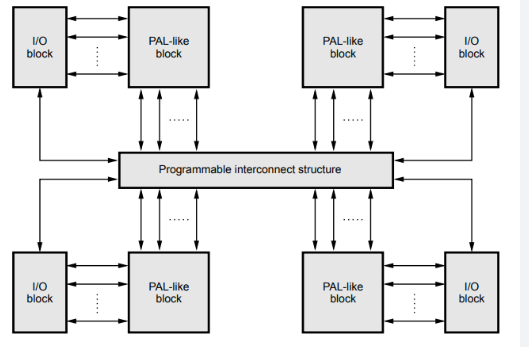
Programmable Logic Blocks (PLBs) / Function Blocks (FBs):These are the core components responsible for implementing logic functions. Each PLB contains multiple product-term generators (AND arrays), OR gates, and flip-flops. The AND arrays generate product terms (logical AND combinations of input signals), which are then combined by the OR gates to form combinational logic. Flip-flops enable the implementation of sequential logic by storing the output of the combinational logic for use in subsequent clock cycles.
Programmable Interconnect Matrix (PIM):This is a network of programmable switches that connects the PLBs, I/O blocks, and other internal components. It allows signals to be routed between different PLBs and to/from the I/O blocks, enabling flexible interconnection of logic functions. The PIM ensures that the user’s logic design can be mapped to the CPLD’s hardware regardless of the physical location of the PLBs.
Input/Output (I/O) Blocks:These blocks serve as interfaces between the CPLD and external devices (e.g., microcontrollers, sensors, displays). Each I/O block can be programmed to act as an input, output, or bidirectional pin. They include buffers, drivers, and voltage level translators to match the electrical characteristics (e.g., voltage, current) of external components, ensuring reliable signal transfer.
Non-Volatile Configuration Memory:This memory stores the configuration data that defines the CPLD’s logic behavior. Common types include EEPROM (Electrically Erasable Programmable Read-Only Memory) and Flash memory. Since this memory is non-volatile, the configuration data is retained even when power is removed, meaning the CPLD is ready to operate immediately upon power-up without the need for an external configuration device.
Clock Distribution Network:This network distributes clock signals to the PLBs and I/O blocks, ensuring that sequential logic elements (e.g., flip-flops) operate synchronously. It includes buffers and dividers to maintain clock signal integrity and allow for multiple clock domains, enabling the CPLD to handle complex timing requirements.
4.1 Automotive Electronics
Body Control Modules (BCM):CPLDs are used to implement logic for controlling car doors (locking/unlocking), windows (up/down), and interior lighting. For example, in a BCM, a CPLD can detect input signals from door lock switches, process the logic to determine whether to lock or unlock the doors, and send control signals to the door lock actuators.
Instrument Clusters:They drive and control the display of gauges (e.g., speedometer, tachometer) by processing sensor signals (e.g., from the vehicle’s speed sensor) and converting them into appropriate display outputs. A CPLD might also handle warning light activation (e.g., check engine, low fuel) based on input from the engine control unit (ECU).
Advanced Driver-Assistance Systems (ADAS):In simple ADAS features like parking sensors, CPLDs process signals from ultrasonic sensors to determine the distance to obstacles and trigger audio or visual alerts for the driver.
4.2 Industrial Automation
Programmable Logic Controllers (PLCs):CPLDs are integrated into PLCs to handle discrete logic tasks such as ladder logic implementation. For instance, in a manufacturing assembly line, a CPLD in a PLC can monitor input signals from limit switches (indicating if a part is in position) and control output signals to activate pneumatic cylinders that move the part to the next station.
Motor Control:They manage the logic for motor start/stop, speed regulation, and direction control in industrial motors (e.g., conveyor belt motors). A CPLD might interface with a motor driver IC, receiving speed commands from a microcontroller and generating the appropriate PWM (Pulse-Width Modulation) signals to adjust the motor’s speed.
Sensor Data Acquisition:CPLDs process signals from industrial sensors (e.g., temperature, pressure, humidity sensors) by amplifying, filtering, and converting analog signals (via external ADCs) into digital data that can be transmitted to a central controller. For example, in a chemical plant, a CPLD might process pressure sensor data to trigger a valve shutdown if pressure exceeds a threshold.
4.3 Consumer Electronics
Set-Top Boxes (STBs):CPLDs handle interface conversion and signal routing. For example, they convert HDMI signals to composite video signals for older TVs, or route audio signals between the STB’s decoder and the TV’s speakers. They also manage remote control signal processing, decoding infrared (IR) signals from the remote and translating them into commands for the STB’s main processor.
Smart Home Devices:In smart thermostats, CPLDs process input from temperature sensors and user interface buttons (e.g., up/down for temperature adjustment) to control the heating/cooling system. They might also handle communication with wireless modules (e.g., Wi-Fi) to send temperature data to a smartphone app.
Gaming Consoles:They are used for peripheral control, such as interfacing with game controllers (e.g., PlayStation DualShock, Xbox Controller) and processing button presses and joystick movements into digital signals that the console’s CPU can interpret.
4.4 Telecommunication Equipment
Router and Switch Interfaces:CPLDs manage signal integrity and protocol conversion at the physical layer (PHY) of network devices. For example, in an Ethernet switch, a CPLD can align data packets, handle clock synchronization between different ports, and convert between different signal formats (e.g., LVDS to TTL).
Base Station Power Management:They control the power distribution to various components of a cellular base station (e.g., transmitters, receivers). A CPLD might monitor the voltage and current of each component and shut down non-essential parts during low-traffic periods to save energy.
Optical Communication Modules:In fiber-optic transceivers, CPLDs process control signals for laser diodes and photodetectors, ensuring stable data transmission by adjusting laser power based on received signal strength.
4.5 Aerospace and Defense
Avionics Systems:CPLDs are used in flight control systems for simple logic tasks like sensor signal conditioning and actuator control. For example, in a small aircraft’s autopilot system, a CPLD might process gyroscope data to stabilize the aircraft’s pitch and roll.
Military Communication Devices:They handle secure signal encoding/decoding and frequency hopping logic in military radios, ensuring that communication is encrypted and resistant to jamming.
Satellite Payload Control:CPLDs manage the activation and deactivation of satellite payloads (e.g., cameras, communication transponders) based on commands from ground control, withstanding the extreme temperature and radiation conditions of space.
In summary, Complex Programmable Logic Devices (CPLDs) are versatile, programmable integrated circuits that play a vital role in modern electronics by enabling custom logic implementation with speed, flexibility, and cost-effectiveness. Composed of programmable logic blocks, an interconnect matrix, I/O blocks, configuration memory, and a clock distribution network, CPLDs operate on a product-term logic structure that ensures predictable timing and reliable performance. Their importance lies in reducing development cycles, lowering costs, and adapting to design changes, making them indispensable across diverse fields. From automotive body control and industrial PLCs to consumer electronics and aerospace systems, CPLDs provide tailored logic solutions for applications ranging from simple interface conversion to medium-complexity sequential control.
Industry Information