
Home > Industry Information > Exploring The Role Of GND In Electronic Components
This passage aims to explore the fundamental role of GND (Ground) in electronic components. It starts with an introduction to the definition, importance, and working principle of GND, followed by a detailed breakdown of different types of GND. Additionally, it elaborates on the practical applications of GND in electronic circuits, and finally summarizes its significance in ensuring the stable and reliable operation of electronic systems.
2.1 What is GND in electronic
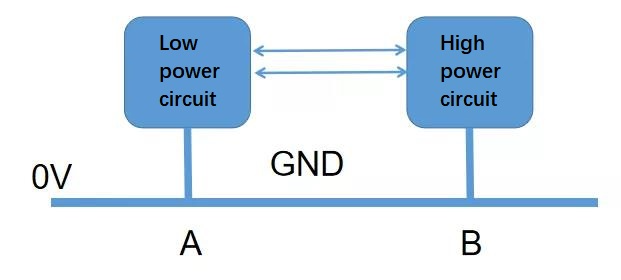
In electronics, GND, short for "Ground," refers to a reference point in an electrical circuit that is defined as having zero potential (0V). It serves as a baseline against which the voltages of other points in the circuit are measured. Functionally, it acts as a common return path for electric current, allowing current to flow from the positive terminal of a power source through various components and back to the negative terminal via GND, completing the circuit.
2.2 The importance of GND
GND is critical to the proper functioning of electronic systems for several reasons. Firstly, it provides a stable reference for voltage measurements, ensuring that components operate within their designed voltage ranges. Without a consistent GND, the relative voltages between components would be ambiguous, leading to erratic behavior or damage. Secondly, it facilitates current flow by offering a low-impedance return path, preventing current from taking unintended routes that could cause interference or overheating. Lastly, GND plays a key role in noise reduction and electromagnetic interference (EMI) shielding, protecting sensitive components from external disturbances and internal signal interference.
2.3 Working principle
The working principle of GND is based on the relativity of electrical potential. By defining a point as 0V, all other voltages in the circuit are measured relative to this reference. Electric current, which flows from higher potential to lower potential, relies on GND as the final destination in the loop: current exits the positive side of the power source, passes through components (performing work such as powering a resistor or transistor), and returns to the negative side of the source via GND. This closed-loop path ensures continuous and controlled current flow. Additionally, GND acts as a "sink" for unwanted signals or noise, absorbing stray currents and preventing them from disrupting the normal operation of the circuit.
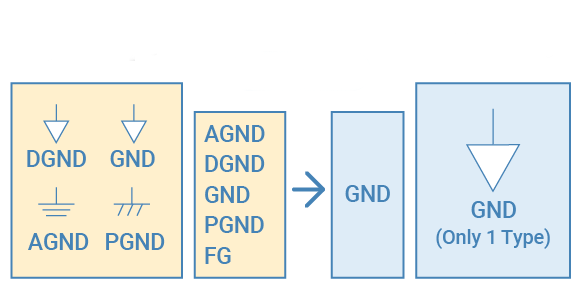
Power Supply Ground (GND):This is the reference point associated with the power supply in a circuit. It ensures that the power supply delivers stable voltages to various components by providing a return path for the current from the load back to the power supply.
Power Ground (PGND):Specifically related to power circuits, PGND handles the high currents generated by power devices such as transistors and voltage regulators. It is designed to minimize voltage drops and noise in power distribution.
Digital Ground (DGND):Used in digital circuits where components operate with discrete voltage levels (e.g., 0V and 5V). DGND provides a stable reference for digital signals, ensuring accurate logic operations and reducing crosstalk between digital components.
Analog Ground (AGND):Employed in analog circuits that process continuous signals. AGND is isolated from digital ground to prevent digital noise from interfering with sensitive analog signals, maintaining the precision of analog measurements and signal processing.
Chassis Ground:Connected to the metal chassis or enclosure of an electronic device. It serves as a safety ground, protecting users from electric shock by diverting fault currents to the ground. It also helps in shielding the internal circuitry from external electromagnetic interference.
Earth Ground:Physically connected to the earth through a conductor. It is primarily used for safety purposes, diverting excess current (such as lightning strikes or short circuits) into the earth to prevent damage to equipment and ensure user safety.
Power Supply Circuits:GND acts as a critical return path for current, enabling the power supply to deliver the required current to components like resistors, capacitors, and integrated circuits. For example, in a 5V DC power supply used in a small electronic project, the current flows from the 5V output through a microcontroller (such as Arduino) and then back to the power supply via the GND connection, forming a closed loop. This ensures stable voltage output, allowing the microcontroller to function properly—executing code, reading sensors, and controlling actuators without voltage fluctuations.
Digital Circuits:Digital Ground (DGND) provides a stable reference for logic gates, microprocessors, and other digital components that operate with discrete voltage levels (e.g., 0V and 5V). In a microprocessor-based system like a home automation controller, DGND ensures that the processor correctly interprets binary signals: a voltage near 5V is recognized as a "1," and a voltage near 0V (DGND) is recognized as a "0." Without DGND, the processor might misread signals due to floating potentials, leading to incorrect operation—for instance, a light switch being toggled unexpectedly or a sensor reading being misinterpreted.
Analog Circuits:Analog Ground (AGND) is essential for maintaining the integrity of continuous signals processed by analog components such as sensors, amplifiers, and filters. In a temperature sensing circuit using a thermistor, AGND provides a stable reference for the analog-to-digital converter (ADC) that converts the thermistor’s resistance (which varies with temperature) into a voltage. If AGND is contaminated by digital noise (e.g., from a nearby microprocessor), the ADC might misread the voltage, resulting in inaccurate temperature readings—reporting 25°C when the actual temperature is 30°C, for example. By isolating AGND from DGND, the circuit ensures precise measurements.
Communication Circuits:GND plays a key role in reducing signal interference, which is vital for reliable data transmission. In USB communication, the differential data lines (D+ and D-) use the USB GND as a reference. When a smartphone connects to a computer via USB to transfer photos, the GND ensures that the voltage differences between D+ and D- are accurately interpreted, preventing data corruption. Without a solid GND connection, noise could distort the signals, causing photos to be corrupted or the transfer to fail entirely. In wireless routers, proper grounding of the RF (radio frequency) circuitry reduces EMI, allowing the router to maintain a stable Wi-Fi connection with devices even in environments with other electronic equipment (like microwaves or cordless phones).
Audio Circuits:A well-designed AGND in audio circuits minimizes noise and hum, resulting in clear sound output. In a home stereo system, the preamplifier, power amplifier, and speakers all rely on AGND. If AGND is poorly designed—for example, with a high resistance path—hum from the power supply (60Hz or 50Hz) can be introduced into the audio signal. This manifests as a low-frequency buzz in the speakers, ruining the listening experience. By ensuring AGND is a low-impedance path and isolating it from digital components (like a CD player’s display circuitry), the system produces clean sound, whether playing music or dialogue.
High-Frequency Circuits:GND planes—large areas of conductive material connected to GND—are widely used in high-frequency circuits (e.g., RF modules or microwave systems). In a 5G base station, which operates at frequencies up to 30GHz, GND planes in the printed circuit board (PCB) act as a low-impedance return path for high-frequency signals. They reduce signal reflection (which can cause signal loss) and suppress EMI, ensuring that the base station can transmit and receive data over long distances with minimal error. Without GND planes, the high-frequency signals would degrade rapidly, leading to dropped calls or slow data speeds for users.
Safety-Critical Devices:Chassis Ground is essential in devices like computers, household appliances, and industrial machinery. In a desktop computer, the metal case is connected to chassis ground. If a wire inside the computer frays and touches the case, the chassis ground diverts the fault current away from the user—so if someone touches the case, they won’t receive an electric shock. In a washing machine, chassis ground ensures that any leakage current from the motor or control board is safely directed away, preventing harm to users. Additionally, the chassis acts as a shield, reducing EMI emissions from the device and protecting it from external interference (like from nearby power lines).
In summary, GND is a fundamental and indispensable element in electronic components and circuits. It serves as a reference point for electrical potential, a return path for current, and a means to reduce noise and interference. The different types of GND, including Power Supply Ground, Power Ground, Digital Ground, Analog Ground, Chassis Ground, and Earth Ground, each have specific roles and applications, ensuring the proper functioning of various circuit types.
Industry Information