
Home > Industry Information > Understand The Function Of EVAP System
This passage aims to provide a comprehensive understanding of the Evaporative Emission Control System (EVAP). It begins with an introduction to the system, including its definition, importance, and working principle. Then, it explores the application fields of the EVAP system with specific vehicle models as examples. Additionally, common malfunctions of the system and corresponding maintenance methods are detailed. Finally, a summary is given to consolidate the key points about the EVAP system.
2.1 What is an EVAP System?
The Evaporative Emission Control System (EVAP) is an integral part of a vehicle's emission control system. Its primary role is to capture and contain fuel vapors that would otherwise escape from the vehicle's fuel tank, fuel lines, and other fuel system components into the atmosphere. These fuel vapors, mainly composed of hydrocarbons, are harmful pollutants, and the EVAP system prevents them from contributing to air pollution.
2.2 The importance of EVAP System
The importance of the EVAP system lies in its significant contribution to environmental protection. By trapping fuel vapors, it reduces the emission of hydrocarbons, which are a major cause of smog and air pollution. This helps vehicles meet strict environmental regulations set by various governments and regulatory bodies worldwide. Moreover, it also prevents the waste of fuel, as the captured vapors are eventually burned in the engine, improving fuel efficiency to some extent.
2.3 Working principle
The working principle of the EVAP system involves several key components working together. The main components include a charcoal canister, a purge valve, a vent valve, and associated hoses. When the vehicle is not running, fuel vapors from the fuel tank are directed to the charcoal canister, where the activated charcoal adsorbs and stores the vapors. When the engine is running, the engine control unit (ECU) opens the purge valve, allowing intake manifold vacuum to draw the stored vapors from the canister into the engine cylinders. Here, the vapors are mixed with air and burned during combustion, converting them into harmless byproducts. The vent valve, on the other hand, allows fresh air to enter the canister to replace the vapors that are purged, ensuring the canister can continue to adsorb new vapors.
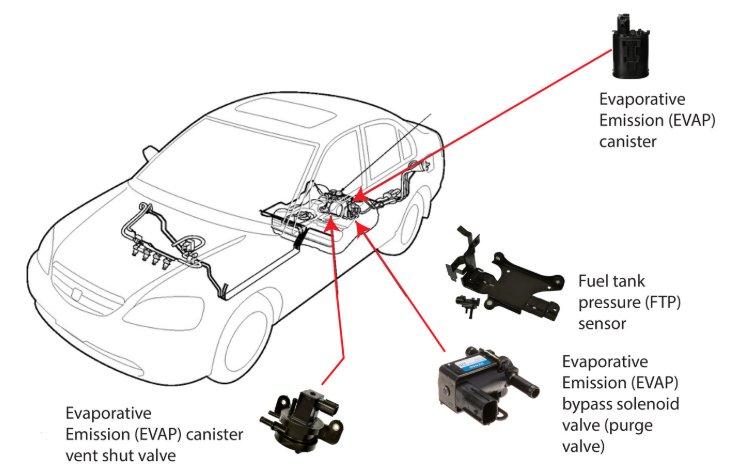
3.1 Passenger Cars:This is the most common application field for EVAP systems, as gasoline-powered passenger cars generate significant fuel vapors during daily use. The EVAP system is essential for these vehicles to control emissions and meet environmental standards.The relevant examples are as follows,
The Toyota Camry, a globally renowned passenger car, is equipped with a sophisticated EVAP system. This system efficiently captures fuel vapors from the fuel tank and related components, ensuring the vehicle complies with emission regulations in various regions while maintaining stable performance.
The Honda Civic, another popular passenger car model, integrates an advanced EVAP system. It effectively manages fuel vapors, contributing to the model's excellent fuel economy and low emission levels, making it a favorite among environmentally conscious consumers.
3.2 Commercial Vehicles:Light-duty trucks and some medium-duty commercial vehicles, which are widely used for transportation and logistics, also rely on EVAP systems. These vehicles often have larger fuel tanks and higher fuel consumption, making the control of fuel vapor emissions crucial.The relevant examples are as follows,
The Ford F-150, a best-selling light-duty truck in the United States, features a robust EVAP system. It is designed to handle the higher fuel vapor output of the truck, ensuring that emissions are kept within legal limits, whether the vehicle is used for personal transportation or commercial hauling.
3.3 Hybrid Vehicles:Hybrid vehicles that combine an internal combustion engine with an electric motor still produce fuel vapors from their gasoline-powered components. Thus, they require EVAP systems to control these emissions and maintain their environmental advantages.The relevant examples are as follows,
The Toyota Prius, a pioneer in hybrid technology, incorporates an EVAP system that works in tandem with its hybrid powertrain. This system ensures that fuel vapors from the vehicle's fuel tank and engine are properly captured and burned, enhancing the overall environmental performance of the Prius.
4.1 Common types of faults
Charcoal Canister Issues:The charcoal canister may become clogged with dirt or saturated with fuel, losing its ability to adsorb vapors. It can also get damaged, such as cracks in the canister body, leading to vapor leaks.
Purge Valve Malfunctions:The purge valve can get stuck in the open or closed position. A stuck-open valve may cause an overly rich fuel mixture, resulting in rough idle and increased fuel consumption. A stuck-closed valve prevents the purging of stored vapors, causing the system to fail.
Vent Valve Problems:The vent valve may fail to open or close properly. If it doesn't open, fresh air can't enter the canister, affecting vapor adsorption. If it doesn't close, the system can't maintain pressure, leading to vapor leaks.
Hose and Connector Leaks:Hoses connecting different components of the EVAP system can crack, split, or become loose at the connectors, causing fuel vapors to leak into the atmosphere.
Sensor Failures:Sensors such as the pressure sensor, which monitors the pressure in the EVAP system, can malfunction. This leads to incorrect readings, causing the ECU to trigger false fault codes or fail to detect actual issues.
4.2 Maintenance methods
Charcoal Canister:If the canister is clogged or saturated, it usually needs to be replaced. For a damaged canister with cracks, replacement is also the recommended solution as repairs are often ineffective.
Purge Valve:First, check if the valve is stuck. Cleaning the valve may resolve minor sticking issues. If cleaning doesn't work or the valve's internal components are worn, replace the purge valve.
Vent Valve:Inspect the valve for blockages or mechanical issues. Cleaning can sometimes fix the problem. If the valve is severely damaged or worn, replace it with a new one.
Hoses and Connectors:Replace cracked or split hoses. Tighten loose connectors; if the connectors are damaged, replace the affected parts to ensure a proper seal.
Sensors:Use a diagnostic tool to test the sensors. If a sensor is confirmed to be faulty, replace it with a compatible new sensor to restore accurate system monitoring.
The Evaporative Emission Control System (EVAP) is a vital component in modern vehicles, playing a crucial role in reducing hydrocarbon emissions and protecting the environment. It works by capturing and reusing fuel vapors, with key components like the charcoal canister, purge valve, and vent valve working in harmony. The system is widely applied in various types of vehicles, including passenger cars, commercial vehicles, and hybrid vehicles, with models like the Toyota Camry, Ford F-150, and Toyota Prius being examples.Like any other system, the EVAP can experience malfunctions such as canister issues, valve problems, leaks, and sensor failures. Timely diagnosis and appropriate repairs, such as replacement of faulty components or cleaning of clogged parts, are essential to maintain its proper functioning. Overall, the EVAP system is indispensable for ensuring vehicles meet emission standards and contribute to a cleaner environment.
Industry Information