
Home > Industry Information > Exploring The Role Of Starter Relays
This passage aims to delve into the crucial role of starter relays in automotive systems. It begins by providing an overview of the starting system and defining what a starter relay is, followed by an explanation of its working principle. Subsequently, it elaborates on the specific functions of starter relays in automobiles, discusses common malfunctions and corresponding maintenance measures, and finally concludes with a summary of their significance. By covering these aspects, the passage seeks to offer a comprehensive understanding of starter relays for readers.
2.1 what is starting system
The starting system is a key component in a vehicle that is responsible for initiating the operation of the engine. Its primary function is to convert electrical energy from the vehicle's battery into mechanical energy, which is then used to crank the engine's crankshaft, enabling the engine to start and run on its own. The starting system typically consists of several components, including the battery, starter motor, starter relay, ignition switch, and related wiring. When the driver turns the ignition key or presses the start button, the starting system is activated, and a series of actions occur to set the engine in motion.

2.2 what is a starter relay
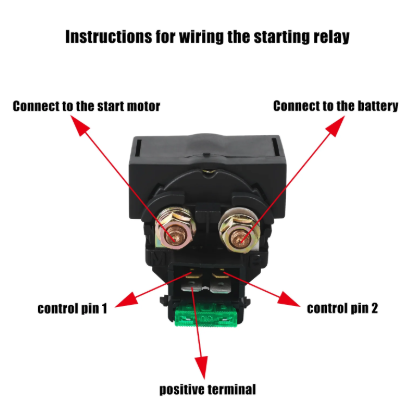
A starter relay is an electromagnetic switch that plays an intermediate role in the vehicle's starting system. It is designed to handle the high current required by the starter motor, which is necessary to crank the engine. As a type of relay, it uses a small current to control a larger current, acting as a bridge between the low-current control circuit (such as the ignition switch) and the high-current starter motor circuit. The starter relay is usually located in the engine compartment, often near the battery or the starter motor itself, and is enclosed in a protective housing to shield it from dust, moisture, and other external factors.
2.3 working principle
The working principle of a starter relay is based on electromagnetic induction. When the driver activates the ignition switch to start the engine, a small current flows from the battery through the ignition switch to the coil of the starter relay. This current causes the coil to generate a magnetic field, which attracts a movable armature within the relay. As the armature moves, it closes a set of heavy-duty contacts within the relay. Once these contacts are closed, a large current is allowed to flow directly from the battery through the relay to the starter motor. This large current powers the starter motor, which then rotates the engine's crankshaft, initiating the engine start. When the driver releases the ignition switch, the current to the relay coil is cut off, the magnetic field collapses, and the contacts open under the force of a spring, stopping the current flow to the starter motor and ending the starting process.
3.1 Protecting the ignition switch:The starter motor needs a large current (often hundreds of amperes) to work, while the ignition switch can only handle a small current (a few amperes). The starter relay acts as a buffer, allowing the small current from the ignition switch to control the relay coil, and the large current for the starter motor flows through the relay's heavy-duty contacts, thus preventing the ignition switch from being burned out by excessive current.
For instance, in the BMW 7 Series, like the F02 model of the 730Li, the starter motor demands a substantial current, far beyond what the ignition switch can handle. The starter relay steps in as a buffer. When the driver turns the ignition key, a small current from the ignition switch activates the relay coil. The large current required by the starter motor then flows through the relay's heavy-duty contacts, rather than passing through the ignition switch. This prevents the ignition switch from being overloaded and potentially burned out, ensuring its long-term reliability and functionality.
3.2 Ensuring reliable operation of the starter motor:The small current from the ignition switch is insufficient to directly drive the starter motor's electromagnetic system. The starter relay amplifies this small current signal through its electromagnetic mechanism, enabling the large current from the battery to reach the starter motor, ensuring it gets enough power to crank the engine effectively even under conditions like low temperatures or battery voltage fluctuations.
Consider the case of the BYD hybrid DM-i models. These vehicles rely on a 12V DC battery and a 12V DC motor for engine starting. When the ignition is turned, the small current from the ignition switch is amplified by the relay. The relay's electromagnetic mechanism enables the large current from the battery to reach the starter motor. Even in situations such as cold starts or when the battery voltage is slightly low, the relay ensures that the motor receives enough power to crank the engine effectively. This is vital for the smooth start of the vehicle, especially in hybrid systems where the proper functioning of the starting process is integral to the seamless transition between electric and combustion engine modes.
3.3 Simplifying the vehicle's electrical circuit design and enhancing safety:Without the starter relay, long and thick wires would be needed to carry large currents from the battery to the ignition switch and then to the starter motor, increasing wiring complexity and cost. The relay separates the low-current control circuit and the high-current starter motor circuit, reducing the length of high-current wires, minimizing voltage drops, simplifying the circuit layout, and reducing the risk of wiring overheating and short circuits, thereby improving overall safety.
Take the example of the Hyundai Sonata NF. In this car, without a starter relay, long and thick wires would be needed to carry the large current from the battery to the ignition switch and then to the starter motor. This would not only increase the complexity and cost of the wiring harness but also pose risks such as overheating and short circuits.
5.1 Common malfunctions
Contact wear or sticking:Due to repeated use, the contacts can become worn, pitted, or stuck. Worn contacts cause high resistance, reducing current flow to the starter motor and leading to slow or ineffective engine cranking. Stuck contacts can make the starter motor run continuously after the engine starts, damaging the motor and draining the battery.
Coil failure:The coil may fail due to overheating, corrosion, or electrical faults. A faulty coil can't generate enough magnetic force to close the contacts, resulting in the starter motor not receiving power and a no-start condition.
Mechanical issues:The movable armature or the return spring can wear or get damaged, preventing the contacts from opening or closing properly, leading to intermittent starting problems or a complete failure to start.
5.2 Maintenance measures
Regular inspection:Check for corrosion, damage, or loose connections on the relay's terminals and wiring. Clean corrosion with a wire brush and ensure all connections are tight.
Testing with a multimeter:If the relay is suspected to be faulty, use a multimeter to check the continuity of the coil and contacts.
Replacement of faulty relays:Replace a faulty relay with a compatible one to ensure proper operation of the starting system.
Keeping the engine compartment clean and dry:This helps reduce the risk of corrosion and contamination, preventing premature failure of the starter relay.
In conclusion, the starter relay is a critical component in the automotive starting system, with a working principle based on electromagnetic induction. It protects the ignition switch, ensures the reliable operation of the starter motor, simplifies the electrical circuit, and enhances safety. Despite being a relatively small component, its role is indispensable for the proper functioning of the vehicle's engine start process. Understanding the common malfunctions and performing regular maintenance on the starter relay can help prevent starting issues and ensure the longevity of the starting system. As automotive technology continues to advance, the starter relay remains a key element in ensuring reliable and efficient engine starting.
Industry Information