
Home > Industry Information > Analysis Of The Differences Between EMMC Storage And Other Storage Methods
I. Introduction to eMMC
Embedded multimedia card, abbreviated as eMMC, is a small chip used for data storage, mainly for storing photos, applications and other data.
eMMC is often used in smart phones, tablet computers and Internet devices, and is also commonly known as "hard disk".
eMMC is an embedded and non-volatile storage system, mainly composed of flash memory, flash memory controller and eMMC protocol interface, which are packaged together in the form of BGA.
The composition analysis of eMMC is as follows:
·Flash memory
Flash memory is a kind of non-volatile memory, usually used for storing data. The flash memory inside the eMMC generally belongs to Nand Flash.
·Flash memory controller
The Flash memory controller is mainly used for operating and managing the internal Nand Flash. Due to the physical characteristics of Nand Flash itself,
many functions such as bad block management, wear balancing, and eMMC need to be implemented, and these functions are realized by FTL (Flash Translation Layer).
The Flash memory controller integrated inside the eMMC realizes functions such as FTL, reducing the complexity of software development caused by various characteristic differences
of different models of Nand Flash. Meanwhile, the Flash Memory controller also provides multiple functions such as Cache, Memory array, and interleave,
which greatly improves the performance of Nand Flash read and write operations.
·eMMC interface
The eMMC interface mainly realizes the connection of eMMC to the Host's MMC bus. Communicate with the Host to implement the protocol logic of eMMC.

The working principle process of EMMC begins with the device startup for initialization, followed by the system receiving instructions for work analysis. Then comes the data reading step,
which includes data reading and writing as well as data erasure. After completing the above steps, eMMC enters the final state feedback state. The following is a brief analysis of the working process of eMMC:
·Initialize
When the device starts up, the eMMC controller initializes, detects the chip status and establishes a communication connection with the host system.
Instruction reception and parsing
The host system sends instructions to the eMMC through the interface, such as reading, writing or erasing data. The eMMC controller receives and parses these instructions
to determine the operation type and the target storage location.
"Data reading"
Addressing: The controller finds the target storage location according to the instructions.
Reading data: The eMMC chip reads data from the designated position and performs error detection and correction (ECC).
Data transmission: The corrected data is temporarily stored in the buffer and then transmitted to the host system through the interface.
· Data writing
Addressing and erasing: The controller locates the target storage block and first performs an erasing operation to restore it to a blank state.
Write data: The host sends data to the eMMC buffer. The controller writes the data to the target storage location and performs write verification and error correction code (ECC) generation.
Update status: After the writing is completed, eMMC updates the storage status to ensure that the data is written correctly.
· Data erasure
Block selection: The controller selects the storage blocks that need to be erased.
Erase execution: The eMMC chip performs an erase operation on the selected block to restore its blank state and prepare for subsequent writing.
·Status feedback
After the instruction operation is completed, the eMMC controller sends status feedback to the host system to inform whether the operation was successful. If it fails,
provide error information so that the host can take corresponding measures.
· Compact size: eMMC integrates the flash memory chip and controller in a small package. This small package method enables it to meet the demands of miniaturized electronic
devices with high space requirements, facilitating the thin and light design of the devices.
· High integration: eMMC combines the memory chip and the control chip together, achieving a high degree of integration, which makes the device design simpler.
· Low power consumption: eMMC is designed with a focus on low power consumption. Its controller can automatically adjust the working mode of the memory chip according to
the working status of the device. This intelligent power consumption management approach enables eMMC to minimize power consumption while ensuring performance,
thereby extending the battery life of the device.
II. The Differences between EMMC and SSD
SSD, as a common solid-state drive assembled on the computer end, is well-known for its high loading speed and good stability. In this chapter, we will compare
EMMC with SSD to analyze the similarities and differences between the two storage devices.
Solid-state drives, abbreviated as SSDS, are computer storage devices made of integrated circuits. They feature fast reading and writing, low power consumption and high reliability,
and are mainly used in computers, servers and other equipment.
In SSD, the read and write operations of data are accomplished through the controller. The read operation is relatively simple. The controller reads data from the specified address and
transmits it to the host. Write operations are much more complicated because the write speed of flash memory is slower and the original data needs to be erased before writing data.
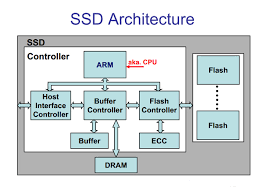
Both eMMC and SSD are solid-state storage devices, but they differ significantly in structure, performance, application scenarios and cost. eMMC is typically used in space-constrained
embedded devices such as smartphones and tablets, while SSD is widely applied in scenarios like personal computers and servers that require high-performance storage.
The differences between eMMC and SSD are as follows:
· Structure:
eMMC packages NAND flash memory chips and control chips in a small chip, with a relatively simple structure, usually consisting of only one or a few NAND chips. SSD, on the other hand,
is composed of multiple NAND flash memory chips, a controller chip and cache, forming an array-like storage structure. Its performance and capacity are both greater than those of eMMC.
· Performance:
Due to the differences in structure and control methods, the read and write speeds of SSDS (especially random read and write speeds) are usually much higher than those of EMMCs.
The multi-path read and write capabilities and more advanced controller chips of SSDS enable them to handle data transmission more quickly, while eMMC performs relatively weakly in this aspect.
· Application scenarios:
eMMC is mainly applied to embedded devices that are sensitive to cost and space, such as smart phones, tablet computers, Internet of Things devices, etc. SSDS are more suitable for computers,
servers and other devices with higher performance requirements, providing faster startup speeds and data processing capabilities.
III. What are the advantages and disadvantages of EMMC compared to common storage methods
eMMC, Flash and UFS are three common storage methods. The following will introduce these two common storage methods, UFS and Flash, as well as their characteristics, and analyze
the differences between them and EMMC in terms of working principle, performance and other aspects.
Flash memory storage is a high-speed memory based on electronic programming, which can flash data and perform random I/O operations. This non-volatile memory does not require
power supply to maintain the integrity of the stored data, so even if there is a power outage, the data will not be lost. It is mainly used in memory cards and USB flash drives.

General-purpose flash storage is a high-performance and low-power storage standard for mobile devices and consumer electronic products. This storage method adopts a serial interface and full-duplex mode,
supporting simultaneous read and write operations.
_906.png "UFS(1).png")
eMMC, Flash and UFS are three common storage methods, but they have some differences in terms of working principle, performance and interface. The following is a simple analysis of the differences among the three:
eMMC:
By adopting parallel interfaces and half-duplex mode, only read or write operations can be performed at the same time, resulting in relatively low transmission efficiency.
UFS:
It adopts a serial interface and full-duplex mode, supports simultaneous reading and writing, and has lower latency and higher bandwidth, thus offering superior performance.
Flash:
Flash can adopt various interfaces, such as SPI interface, SD interface, etc. It features fast read and write speeds, large capacity, and relatively low cost. However, its write and erase speeds are relatively slow,
and there is a certain limit on the number of writes.
eMMC, as a storage technology integrating flash memory storage chips and controllers, features compactness, high performance and low power consumption. With the development of technology.
The continuous improvement of eMMC's performance has made its application in fields such as mobile devices, embedded systems and consumer electronics more extensive.
With the advancement of the manufacturing process of memory chips, the storage capacity of eMMC has been continuously expanding, thereby meeting users' demands for large-capacity storage.
The application fields of eMMC are constantly expanding, covering multiple areas such as mobile devices, embedded systems, automotive electronics and the Internet of Things. In the field of mobile devices,
eMMC is widely used in products such as mobile phones, tablet computers and portable music players, providing users with high-speed and stable storage experiences. In the field of embedded systems,
eMMC is widely used in industrial control, home and equipment, etc., meeting the requirements for reliability and stability.
As an integrated embedded storage technology, eMMC achieves reliable data storage and transmission through efficient controllers and optimized flash memory management technology.
With its compact size, high integration and excellent power consumption management, it has been widely applied in numerous electronic devices. Although it has significant differences in structure
and performance from other storage methods such as SSD, Flash and UFS, each has its own advantages and disadvantages. With the continuous advancement of technology, the performance and capacity
of eMMC are also constantly improving, further expanding its application fields.
Industry Information