
Home > Industry Information > Force Sensitive Resistors:Core Features,Classifications And Comparative Performance
This passage systematically elaborates on the core principles, classifications, pros and cons, and diverse applications of Force Sensitive Resistors (FSR).It also compares FSR with mainstream pressure sensing technologies to clarify its unique application value in modern sensing scenarios.
2.1 What is a Force Sensitive Resistor (FSR)
A Force Sensitive Resistor is a passive sensing component whose electrical resistance varies dynamically with external applied force or pressure.It belongs to flexible pressure sensing devices and converts mechanical force signals into measurable electrical resistance signals.
2.2 Importance in Modern Electronics, Human-Machine Interfaces, and Sensing Systems
FSR serves as a core lightweight sensing unit for modern miniaturized electronic devices and intelligent interaction systems.It bridges mechanical contact and electrical signal feedback, realizing real-time force perception for human-machine interaction and intelligent sensing.Its flexible characteristics fill the technical gap of traditional rigid sensors in wearable and compact sensing scenarios.
2.3 Key Features and Advantages
(1) Detects and measures applied force or pressure through resistance changes:FSR’s internal resistance changes correspondingly with external applied force or pressure.This characteristic enables real-time detection and quantitative measurement of mechanical pressure signals.
(2) Provides a simple, low-cost solution for force sensing applications:FSR features a simple working principle and structural design without complex assembly.It greatly reduces application costs and delivers high cost performance for civilian force sensing scenarios.
(3) Offers thin, lightweight, and flexible form factors for compact designs:FSR adopts ultra-thin, lightweight and flexible structural materials.It adapts to curved and narrow installation spaces and supports miniaturized and compact product design.

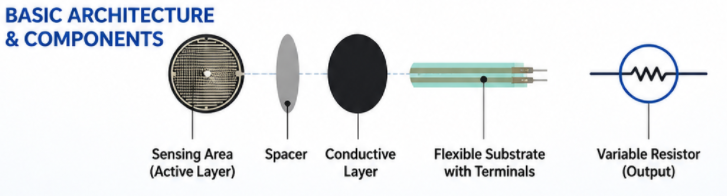
2.4 Basic Architecture and Components
(1) Force-sensitive conductive polymer layer:The conductive polymer layer serves as the core functional layer of FSR.Its internal conductivity changes under force, realizing the conversion of mechanical signals to electrical signals.
(2) Interdigitated electrode pattern:The interdigitated electrode forms a stable conductive loop with the polymer layer.It effectively collects resistance variation signals and ensures uniform sensing performance of the sensor surface.
(3) Spacer and insulating layers:Spacer and insulating layers isolate internal conductive structures of FSR.They prevent short circuits and maintain stable initial working state of the sensor.
(4) Flexible substrate material:The flexible substrate provides mechanical support for all functional layers of FSR.It endows the sensor with excellent bending resistance and flexible deformation capability.
(5) Signal conditioning and interface circuitry:The circuitry processes and optimizes weak resistance signals generated by FSR.It converts original analog signals into standard signals recognizable by terminal devices.
3.1 Circular FSR Sensors
Circular FSR sensors feature a symmetrical circular sensing area with uniform force bearing performance. They are mostly applied in point-type pressure detection scenarios such as button and contact sensing. Their regular shape facilitates fixed installation and standardized equipment assembly.
3.2 Square and Rectangular FSR Sensors
Square and rectangular FSRs have regular planar structures with large and uniform sensing areas. They are suitable for surface uniform pressure detection in flat contact scenarios. These sensors are widely used in flat touch and pressure induction modules.
3.3 Strip-Type FSR Sensors
Strip-type FSRs are long and narrow in shape with linear distributed sensing areas. They are mainly used for linear pressure detection and strip contact force monitoring. They adapt to narrow and long installation spaces such as equipment edges and strip structural parts.
3.4 Matrix and Array-Based FSR Sensors
Matrix FSRs are composed of multiple sensing units arranged in an array structure. They can realize multi-point and regional distributed pressure detection and force mapping. They are core components for high-precision pressure distribution perception systems.
3.5 Flexible and Wearable FSR Designs
Wearable FSRs adopt ultra-thin and super-flexible materials with good skin compatibility. They can be attached to human skin or integrated into textiles for body movement and pressure monitoring. They are lightweight and deformable, suitable for long-term wearable intelligent monitoring scenarios.
3.6 Custom-Shaped and Application-Specific FSR Sensors
Custom FSRs can be tailored into irregular shapes according to specific application scenarios. They match the special structural shapes of customized equipment and special sensing positions. They solve the sensing adaptation problem of non-standard and special industrial scenarios.

4.1 FSR vs Load Cell Sensors
Load cell sensors achieve high-precision heavy-load force detection but are bulky and rigid. By contrast, FSR is lightweight and flexible but inferior in detection accuracy and load range. FSR is more suitable for lightweight civilian scenarios, while load cells apply to industrial high-precision weighing.
4.2 FSR vs Strain Gauge Sensors
Strain gauge sensors rely on structural strain for force detection with high stability and precision. FSR has simpler structure and lower cost but poorer long-term detection stability than strain gauges. Strain gauges are for high-precision industrial testing, and FSR for daily intelligent interaction sensing.
4.3 FSR vs Piezoelectric Sensors
Piezoelectric sensors excel at dynamic and instantaneous pressure signal detection with fast response speed. FSR is better at static and continuous pressure monitoring with stable signal output. The two have obvious differences in applicable dynamic and static sensing scenarios.
4.4 FSR vs Capacitive Pressure Sensors
Capacitive sensors feature high sensitivity and anti-interference performance with complex manufacturing. FSR has simpler manufacturing process and lower cost but slightly lower detection sensitivity. FSR has higher cost-performance for low and medium-precision mass application scenarios.
4.5 Advantages and Limitations of FSR Technology
FSR’s core advantages lie in low cost, flexible design, lightweight and simple integration. Its main limitations include limited precision, poor heavy-load resistance and slight signal drift. It is suitable for general sensing scenarios but not for high-precision industrial detection.

5.1 Consumer Electronics and Touch Interfaces
FSR is extensively adopted in smart terminals to achieve high-sensitivity touch and pressure perception. It enables multi-dimensional interactive experience and supports the lightweight design of consumer electronic products.
5.2 Robotics and Gripping Force Detection
FSR sensors are deployed on robotic grippers for real-time gripping force monitoring. They prevent over-clamping damage and improve the flexibility and safety of robot grasping operations.
5.3 Medical and Healthcare Monitoring Devices
FSR serves in medical monitoring and rehabilitation devices to collect human pressure data. It provides reliable sensing data for health assessment and postoperative rehabilitation training.
5.4 Automotive Control and Occupancy Detection Systems
FSR is applied to automotive interior sensing for seat occupancy and pressure detection. It facilitates intelligent vehicle control and enhances passenger travel safety and vehicle intelligence.
5.5 Industrial Automation and Human-Machine Interfaces (HMI)
FSR provides stable pressure sensing for industrial human-machine interaction equipment. It optimizes operational control accuracy and improves the automation level of industrial production.
5.6 Wearable Electronics and Smart Textiles
Ultra-flexible FSR can be embedded into smart textiles and wearable electronic devices. It realizes real-time monitoring of human movement pressure and promotes the upgrading of intelligent wearable products.

FSR is a low-cost, flexible and lightweight pressure sensing device with unique structural and performance advantages.Despite minor precision limitations, it has irreplaceable application value in civilian intelligence, robotics, medical and wearable fields.
Industry Information