
Home > Industry Information > Rheostat Vs Potentiometer:Structural Differences,Performance Comparison And Selection Guidelines
Rheostats and potentiometers are two core types of variable resistors widely used in electronic circuits with distinct functional attributes. This paper focuses on their structural and performance differences through targeted comparative analysis. It also summarizes targeted selection methods to guide practical circuit design applications.
2.1 What Is a Rheostat
A rheostat is a two-terminal passive variable resistor dedicated to circuit current control. It changes the circuit’s total current by adjusting its internal resistance value. It is exclusively designed for high-current and high-power industrial circuit regulation scenarios.
2.2 What Is a Potentiometer
A potentiometer is a three-terminal precision variable resistor that acts as a professional voltage divider. Its sliding wiper can output continuous and adjustable voltage signals. It is mainly applied for low-power precise voltage tuning and weak signal adjustment.
2.3 Importance of Variable Resistors in Electronic Circuits
Variable resistors are indispensable passive components in modern electronic circuit systems. They support flexible real-time adjustment of current, voltage and signal parameters. They effectively stabilize circuit operation and meet diverse functional design requirements.
2.4 Purpose of Comparing Rheostats and Potentiometers
Rheostats and potentiometers are easily confused in application due to identical variable resistance properties. This comparison explicitly distinguishes their structural and functional essential differences. It provides accurate, practical criteria for engineers to select suitable components for specific circuits.
3.1 Number of Terminals
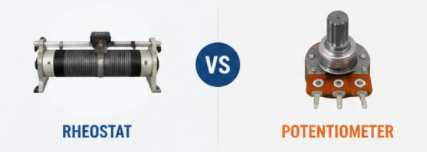
Rheostats adopt a simple two-terminal structure for unidirectional current control only. In contrast, standard potentiometers apply a three-terminal structure to realize voltage division functions. The difference in terminal numbers fundamentally differentiates their circuit connection and working modes.
3.2 Internal Resistive Element Design
Rheostats are equipped with thick, low-precision resistive elements to withstand heavy current and high heat. Potentiometers adopt thin, uniform resistive elements to guarantee high-precision resistance adjustment. Their internal structural designs cater to power resistance and precision control respectively.
3.3 Wiper Mechanism and Adjustment Method
Both components adjust effective resistance via sliding wiper movement, yet their adjustment performances differ greatly. Rheostats prioritize stable mechanical adjustment for heavy-load working environments. Potentiometers feature ultra-smooth fine adjustment for high-precision signal calibration.
3.4 Power Handling Capability
Rheostats possess excellent high-power bearing capacity and adapt to large-current circuits. Potentiometers have limited power tolerance and can only work stably in low-power signal circuits. This power handling gap is one of the most critical structural differences between the two devices.
3.5 Physical Size and Construction
High-power rheostats have large overall sizes and reinforced rugged structures for industrial loads. Potentiometers feature miniaturized, lightweight designs suitable for compact electronic equipment. Their physical structures are optimized for their respective application scenarios.

4.1 Current and Voltage Control Capability
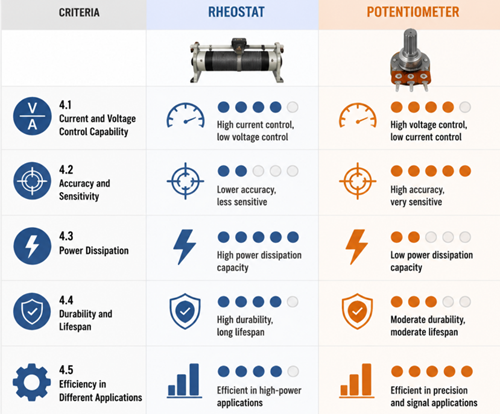
Rheostats are specialized in continuous, stable current regulation for high-power load circuits. Potentiometers excel at precise voltage distribution and fine adjustment of analog signal voltage. The two devices show completely different control advantages in current and voltage regulation.
4.2 Accuracy and Sensitivity
Potentiometers deliver higher sensitivity and adjustment accuracy for subtle parameter tuning. Rheostats sacrifice precision for operational stability under heavy current loads. Such performance differences match fine precision and coarse regulation demands respectively.
4.3 Power Dissipation
Rheostats are professionally designed to continuously dissipate large excess power in high-load circuits. Potentiometers generate negligible power loss during low-power signal adjustment processes. Their power dissipation levels fully match their distinct power application positioning.
4.4 Durability and Lifespan
Rheostats own superior heat and impact resistance for long-term high-current operation. Potentiometers maintain a stable service life only under light and low-load working conditions. Their durability and lifespan are highly dependent on their operating load limits.
4.5 Efficiency in Different Applications
Rheostats achieve high working efficiency in motor control and industrial power circuits. Potentiometers perform excellently in audio debugging, sensor calibration and precision signal processing. Targeted selection can maximize the operating efficiency of electronic circuits.
5.1 Based on Circuit Requirements
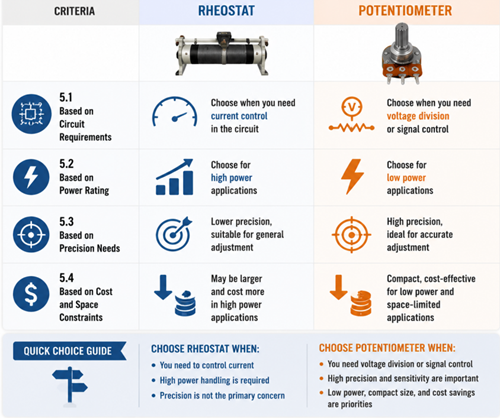
Rheostats are the optimal choice for circuit scenarios requiring current regulation and power control. Potentiometers are preferred for voltage division and precise analog signal adjustment tasks. Specific circuit functional requirements are the primary principle for component selection.
5.2 Based on Power Rating
High-power industrial circuits must adopt high-tolerance rheostats to bear large loads. Low-power precision signal circuits are perfectly compatible with ordinary potentiometers. Matching component power rating with circuit load prevents equipment damage and operational failure.
5.3 Based on Precision Needs
High-precision tuning scenarios need sensitive and accurate potentiometers for subtle parameter adjustment. Conventional coarse current control scenarios can adopt low-precision and stable rheostats. The required adjustment precision directly determines the final component selection.
5.4 Based on Cost and Space Constraints
Miniaturized, low-cost potentiometers fit consumer electronic devices with strict space and budget limits. Large-sized high-power rheostats are more suitable for industrial equipment without space constraints. Comprehensive consideration of cost and space ensures optimal overall circuit design.
Rheostats and potentiometers have obvious differences in structure, power performance and application fields. Rheostats focus on high-stability current regulation for high-power circuits, while potentiometers specialize in high-precision voltage signal adjustment. Distinguishing their characteristics helps designers select components scientifically and improve circuit rationality.
Industry Information