
Home > Industry Information > Switch-Mode Power Supply Basics: The Core Of Efficient Power Conversion
This passage introduces the Switch-mode Power Supply (SMPS) , explaining how it achieves high efficiency by using switching devices that rapidly turn fully on and off. It covers the core operating principle of "chopping" and PWM, the function of key internal components, and main classifications like AC/DC and DC/DC converters. The text also discusses development trends, weighs the advantages (high efficiency, small size) against limitations (noise, complexity), and highlights its critical role in modern electronics.
The core concept of an SMPS is to use semiconductor switching devices—such as MOSFETs or IGBTs—that rapidly alternate between two states:
Fully ON (low resistance, minimal power loss)
Fully OFF (no current flow)
By operating primarily in these two states, power dissipation is greatly reduced. The switching action generates high-frequency voltage pulses, which are then processed through inductors, capacitors, and transformers to produce a stable DC output voltage. Unlike linear regulators, which operate in the active (linear) region and continuously dissipate excess power as heat, SMPS regulates output voltage by adjusting the duty cycle (the ratio of ON time to total switching period). This allows for much higher energy conversion efficiency.
The operation of an SMPS is based on the principle of "chopping." It "chops" the input DC voltage into a series of constant-amplitude voltage pulses. These pulses can then be increased or decreased in amplitude using a transformer, and finally rectified and filtered to obtain a stable DC output.
·Chopping and Pulse Width Modulation (PWM): The input DC voltage is converted into a high-frequency square wave pulse. The width (duty cycle) of these pulses is adjusted by a control circuit based on the output requirements. A higher duty cycle means more energy is transferred to the output, resulting in a higher output voltage.
·Application of High-Frequency Transformers: The high-frequency AC square wave generated by chopping can be fed into a small, lightweight high-frequency transformer to step voltage up or down. This high-frequency operation is the key to the SMPS's miniaturization.
·Regulation Control Loop: A controller continuously monitors the output voltage and compares it with a voltage reference. Any deviation creates an error signal via an error amplifier. This error signal then adjusts the Pulse Width Modulation (PWM) or Pulse Frequency Modulation (PFM) signal that drives the switching transistor. This closed-loop control ensures a stable output voltage despite variations in load and input voltage.
SMPSs primarily operate in two main modes: forward-mode and boost-mode, each with different circuit layouts and operational processes suitable for different applications.

A typical SMPS consists of four main parts:
Main Circuit: This is the power handling path, including:
·Input Filter: Filters noise from the mains and prevents interference generated by the supply itself from feeding back into the grid.
·Input Rectifier & Filter: Rectifies the incoming AC (Alternating Current) into a smooth DC (Direct Current).
·Inverter: Converts the rectified DC back into high-frequency AC. This is the core part of the high-frequency SMPS.
·Output Rectifier & Filter: Rectifies the high-frequency AC again to produce a stable DC output for the load.
·Inrush Current Limiter: Limits the initial surge of current when the power is first turned on.
Control Circuit: This is the "brain" of the supply. It samples the output, compares it to a set value, and controls the inverter by adjusting the PWM or PFM signal to stabilize the output. It also implements various protection measures based on data from the detection circuit.
Detection Circuit: Provides operating parameters (like voltage, current, temperature) for instrumentation or to trigger the protection circuits.
Auxiliary Power Supply: Powers the control circuit, protection circuit, and ICs (like the PWM controller), enabling functions like remote start-up.

SMPSs are mainly divided into two categories: AC/DC (Alternating Current to Direct Current) and DC/DC (Direct Current to Direct Current). Currently, DC/DC converters are highly modular with mature technology, while the modularization of AC/DC converters faces more technical challenges.
·Miniature Low-Power SMPS: These are becoming increasingly popular and miniaturized, gradually replacing traditional transformers in applications like electricity meters, smart meters, and mobile phone chargers.
·Flyback Converter: A common topology where the output voltage polarity is inverted (negative) compared to the input, unlike a forward converter.

The main development directions for SMPSs are:
·High-Frequency Operation: This is the key technology for achieving miniaturization and lighter weight, driving the development of new magnetic materials and low-loss components.
·High Reliability: Improving product lifespan and stability by reducing device stress and optimizing thermal design.
·Low Loss & Soft-Switching Techniques: Using techniques like Zero-Voltage Switching (ZVS) and Zero-Current Switching (ZCS) to significantly reduce switching losses and improve efficiency.
·Low Noise & EMI Suppression: Controlling noise through optimized circuit design (e.g., resonant converters) and physical layout, even at high frequencies.
·Modularization: Modular power supplies allow for the flexible construction of distributed power systems, enabling N+1 redundancy and parallel capacity expansion. This is a major trend in system design.
Main Advantages:
·High Efficiency: Typically 80% to over 90%, much higher than linear power supplies.
·Small Size & Light Weight: High-frequency transformers and filter components are much smaller than their low-frequency (line frequency) counterparts.
·Wide Input Voltage Range: Can accommodate a broad range of input voltages without significant performance loss.
Main Limitations:
·Circuit Complexity: More complex design and generally higher manufacturing cost.
·Switching Noise & EMI: The high-speed switching generates noise that requires careful filtering and shielding.
·Higher Output Ripple: The output voltage typically has higher ripple and noise compared to linear supplies.
Due to their high efficiency and compact size, SMPSs are used in virtually every sector of electronics:
Consumer Electronics: Mobile phone chargers, laptop adapters, TVs, set-top boxes.
Computing & Communications: Server power supplies, telecom base station equipment.
Industrial Control: PLCs (Programmable Logic Controllers), industrial instrumentation, motor drives.
Renewable Energy & Lighting: LED drivers, electric vehicle battery chargers.
Medical Equipment: Various portable and stationary medical devices.
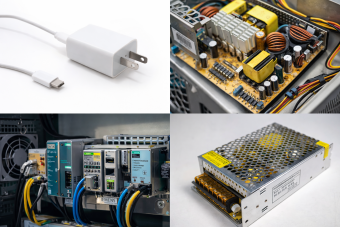
In summary, the Switch-mode Power Supply (SMPS) is an indispensable core component of modern electronic devices. With its significant advantages of high efficiency, small size, and light weight, it has largely replaced traditional linear power supplies and become the mainstream technology in power conversion. Its operating principle ingeniously combines high-frequency chopping, transformer isolation, and PWM feedback control. Although this introduces challenges like design complexity and electromagnetic noise, continuous technological innovation—such as new power devices (like GaN, SiC), soft-switching topologies, improved magnetic materials, and modular design—is constantly pushing its performance boundaries.
Industry Information