
Home > Industry Information > Circuit Board Components Explained: The Cornerstone Of Modern Electronic Devices
In today’s rapidly advancing technological era, electronic devices have become an integral part of everyday life. From smartphones and laptops to smart home systems and automotive electronics, all these products rely on a fundamental hardware platform—the circuit board. A circuit board is not merely a physical support for connections; every component mounted on it plays a critical role in enabling the overall functionality of the electronic system.
What Are Circuit boards and Circuit Board Components?
A circuit board usually refers to a Printed Circuit Board (PCB). It is composed of an insulating substrate, conductive copper traces, and various electronic components. Together, these elements provide both mechanical support and electrical interconnection, allowing complex circuits to operate reliably and efficiently.
Circuit board components are electronic devices soldered onto a PCB to perform specific electrical functions. Each component has a unique role, such as storing energy, controlling current flow, processing signals, or interacting with external environments. Understanding these components is fundamental to electronic design, manufacturing, and troubleshooting.
The table below summarizes the twelve key component categories found on circuit boards and their core functions, providing you with a quick overview:
Component Category | Core Function & Role | Typical Examples & Notes |
Resistor | Limits current, regulates voltage, divides voltage/shunts current, dissipates electrical energy as heat. | Axial resistors are most common, using a color code to indicate resistance value and tolerance; one of the most widely used components in circuits. |
Capacitor | Stores electrical charge and energy; used for filtering, coupling, bypassing, timing, tuning. | Classified by dielectric material, which determines capacitance and characteristics; often two-terminal cylindrical or surface-mount packages. |
Potentiometer | Adjustable resistor, used for continuously varying voltage, current, or signal strength. | Divided into linear (slider) and rotary types; commonly used for volume control, brightness adjustment, etc. |
Inductor | Stores magnetic energy, passes DC while impeding AC; used for filtering, oscillation, delay, notch filtering. | Typically constructed from coiled wire, where the number of turns affects inductance; along with resistors and capacitors, forms the three fundamental passive linear components. |
Diode | Allows current flow in one direction only; used for rectification, detection, voltage regulation, isolation, protection. | LED (Light Emitting Diode) is most common; polarity must be observed during installation, otherwise it won't function. |
Transistor | Signal amplification and electronic switching; the fundamental building block of analog and digital circuits. | Bipolar Junction Transistors (BJTs) come in NPN and PNP types; Field-Effect Transistors (FETs) control current via an electric field. Billions can be integrated on a single chip. |
Integrated Circuit (IC) | Miniaturized transistors, resistors, capacitors, and other circuits integrated onto a semiconductor die, enabling complex functions. | Acts as the "brain" of a circuit (e.g., CPU); often in black plastic packages; core to modern device intelligence. |
Transformer | Transforms AC voltage/current, enables power transfer, impedance matching, and electrical isolation. | Consists of primary/secondary coils and a core; used from large power transformers to small switch-mode power supplies. |
Thyristor (SCR) | High-power controlled rectification and contactless switching, controls large currents. | Also known as Silicon Controlled Rectifier, made from four layers of semiconductor;常用于电机控制,调光,稳压电路。Common in motor control, dimming, voltage regulation circuits. |
Crystal Oscillator | Provides a high-precision, highly stable reference clock signal. | Uses the piezoelectric effect of a quartz crystal to generate oscillation; key for timing in microcontrollers, clocks, communication equipment. |
Switch & Relay | Controls circuit on/off state; a relay is an electrically controlled switch using a small current to control a larger one. | Switches come in many forms (toggle, pushbutton, rotary, etc.); relays use an electromagnet for automatic control and isolation. |
Sensor | Detects changes in external physical parameters and converts them into a measurable electrical signal. | Many types exist (temperature, humidity, light, pressure, motion, etc.); the interface for device perception and environmental interaction. |

Resistors, Capacitors, Inductors: Known as the three fundamental passive linear components. Resistors dissipate energy, capacitors store energy in an electric field, and inductors store energy in a magnetic field. Together they form the basic parameter network of a circuit, determining signal response characteristics.
Potentiometer: As a special type of variable resistor, its ability for continuous resistance adjustment makes it key for human-machine interaction (like volume control) and circuit parameter fine-tuning.
·Diode: Its unidirectional conductivity is the basis of rectifier circuits (converting AC to DC). Light-emitting diodes directly convert electrical energy to light, with extremely wide applications.
·Transistor: Hailed as the cornerstone of modern electronics. Its amplification allows weak signals to be strengthened; its switching action is the physical implementation of binary operations (0s and 1s) in all digital circuits, including CPUs.
·Thyristor (SCR): Excels at handling high power. It can be triggered into conduction by a single pulse and remains on until current conditions change, making it ideal for applications requiring stable control of large currents, like industrial heating or light dimming.

·Integrated Circuit (IC): Through photolithography, billions of transistors and other elements are integrated onto a silicon die the size of a fingernail, enabling the leap from simple logic gates to central processors. It represents the concentration of system complexity and intelligence.
·Crystal Oscillator: The stable clock it provides is like the heartbeat of the system, ensuring synchronized and precise operation of all digital circuit parts. It is fundamental to modern communication, computation, and timing.
·Sensors & Relays: Sensors are the system's "senses" to perceive the world, converting physical information like temperature, light, and pressure into electrical signals. Relays act as the "muscles" connecting low-power control to high-power execution, enabling automation—for example, using a microcontroller's small signal to switch a household appliance.
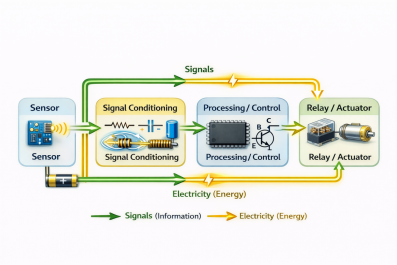
These twelve components collectively cover the essential functional modules of a circuit board:
Energy storage: capacitors, inductors
Current and signal control: resistors, diodes, transistors
Signal processing and timing: integrated circuits, crystal oscillators
System interaction and control: switches, relays, sensors
By working together, these components enable circuit boards to perform tasks ranging from basic power regulation to complex data processing and intelligent control.
From the most basic resistors and capacitors to highly integrated chips, and further to sensors interacting with the environment, each component on a circuit board plays an indispensable role. They function like a precisely coordinated miniature city: passive components build the foundational infrastructure, semiconductors process information and energy, functional modules enable complex intelligence, while sensors and switches communicate with the internal and external world. Understanding these components is not only the starting point for comprehending how electronic devices work but also the foundation for designing, repairing, and innovating electronic products. It is these seemingly tiny components, through ingenious circuit design and layout, that collectively compose the brilliant movement of our digital age.
Industry Information