
Home > Industry Information > A Comprehensive Guide To Proximity Sensors
Proximity Sensors are non-contact sensing devices capable of detecting the presence, distance, and even position of nearby objects without any physical touch. They operate by sensing changes in physical quantities such as electromagnetic fields, light signals, or sound waves. In modern industrial automation, they are the cornerstone for ensuring efficient, safe, and precise operations, earning the title of the "eyes" of machinery. In consumer electronics, they are crucial for enabling intelligent interaction and enhancing energy efficiency. Their non-contact nature prevents mechanical wear, offering core advantages like high reliability, long lifespan, and fast response speeds.
A proximity sensor is a type of sensor that can detect the presence or approach of an object without any physical contact. It works by sensing changes in its surrounding environment when a target object enters a predefined detection range, and then converting those changes into electrical or control signals. Proximity sensors are widely used in automation, consumer electronics, automotive systems, and industrial applications.

The core function of a proximity sensor is based on generating a specific type of sensing field—such as an electromagnetic field, electric field, light, or sound waves. When an object enters this field or alters its characteristics, the sensor detects the change and produces an output signal.
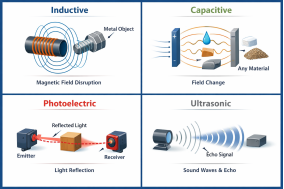
Common operating principles include:
Electromagnetic induction: Detects metal objects by sensing disturbances in a magnetic field
Capacitance variation: Detects changes in an electric field caused by nearby objects
Optical reflection or interruption: Uses light beams to detect reflected or blocked light
Ultrasonic echo: Measures the time it takes for sound waves to reflect back from an object
Different operating principles make proximity sensors suitable for detecting various materials, such as metals, plastics, liquids, or transparent objects.
Based on their detection principles, proximity sensors can be classified into several major categories:
Feature / Type | Inductive Proximity Sensor | Capacitive Proximity Sensor | Photoelectric Proximity Sensor | Ultrasonic Proximity Sensor |
Basic Principle | Uses a coil to generate a high-frequency electromagnetic field. When a metal target enters, it induces eddy currents, causing a detectable field change. | Creates an electrostatic field. Any object (conductor or insulator) with a dielectric constant different from air causes a detectable capacitance change. | Emits a light signal (infrared or laser) and detects objects by analyzing the reflected light's intensity, time-of-flight, or phase shift. | Emits ultrasonic pulses and calculates distance by measuring the time for the echo to return. |
Typical Detection Target | Metallic objects (iron, aluminum, copper, etc.). | Almost all materials: metals, plastics, wood, liquids, and the human body. | Most opaque or translucent objects; some models detect transparent objects. | Almost all materials; insensitive to surface color and reflectivity. |
Detection Range | Short, typically a few millimeters to several tens of millimeters, influenced by metal type and size. | Short to medium, from a few millimeters to several tens of millimeters. | Wide, from a few millimeters to tens of meters, depending on the type (e.g., through-beam, diffuse-reflective). | Long, up to several meters or more. |
Key Advantages | Responds only to metals, strong noise immunity; resistant to harsh environments like oil and dust; robust structure. | Detects non-metals; suitable for liquid/level sensing; adjustable sensitivity. | Long range, fast response, high precision; enables complex logic like background suppression. | Unaffected by color, transparency, or ambient light; suitable for complex surfaces and harsh environments. |
Limitations | Detects metals only; range reduces for non-ferrous metals (e.g., aluminum, copper). | Sensitive to humidity, temperature; range/accuracy can vary with object material and size. | Susceptible to ambient light interference; difficult with transparent, highly reflective, or light-absorbing objects; lenses must stay clean. | Relatively slower response; accuracy affected by temperature, airflow; has a minimum blind zone. |
Typical Applications | Machine tool positioning, cylinder position detection, metal part counting. | Liquid/level control, non-metal object detection, human presence sensing. | Conveyor object detection, packaging positioning, safety light curtains, AGV obstacle avoidance. | Parking assistance, level monitoring, robot collision avoidance, transparent object detection. |
Selecting and applying proximity sensors requires careful consideration of the following core parameters and environmental factors:
Detection Characteristics:
·Rated Sensing Distance: The maximum distance at which the sensor can reliably detect a standard target (specified material and size). For reliable operation, a practical operating distance (typically ~81% of the rated distance) is often used.
·Response Frequency: The number of detection-output cycles the sensor can complete per second. Critical for high-speed tasks like object counting on production lines.
·Repeatability: The consistency of the sensor's output when detecting the same position under identical conditions.
Environmental & Installation Factors:
·Target Object Properties: The object's material, size, shape, color (for photoelectric types), and surface condition significantly impact performance. For example, inductive sensors have a shorter range for aluminum; small objects may require closer mounting.
·Mutual Interference: Multiple sensors of the same type mounted close together can interfere via their magnetic fields or sound waves, causing false triggers. Solutions include maintaining sufficient spacing or using models with staggered operating frequencies.
·Environmental Conditions: Factors like temperature, humidity, oil, dust, vibration, and ambient light must be considered. Choose sensors with an appropriate protection rating (e.g., IP67).
Electrical & Output Characteristics:
·Supply & Output Type: DC (e.g., 12-24V DC) or AC supply, and NPN (sinking) or PNP (sourcing) transistor output must match the input module of the controller (e.g., PLC).
·Connection Method: Cable exit or connector types, chosen for ease of installation and maintenance.

The application of proximity sensors is expanding from traditional industrial automation into broader smart domains, with the technology itself continuously evolving:
Enabling New Markets & High-Value Applications:
·Autonomy & Automation: Enabling obstacle avoidance and navigation in service robots and drones; enabling privacy-protecting people counting in retail without cameras.
·Safe Operation: As a core component of industrial safety systems, monitoring robot workspaces or blind spots of hazardous machinery for area guarding.
·Energy Efficiency: Used in smart buildings for occupancy detection to auto-control lighting and HVAC; in smart appliances to wake devices upon user approach, saving energy.
Technological Innovation Directions:
·Higher Precision & Intelligence: Employing Time-of-Flight and high-resolution measurement (e.g., HDDM+), combined with algorithms to filter interference from rain, fog, and dust for stable, millimeter-level precision in complex environments.
·Fusion & Integration: Integrating proximity sensing with position and speed measurement on a single chip, or combining with smart interfaces like IO-Link for remote configuration, diagnostics, and parameter adjustment, supporting Industry 4.0 and predictive maintenance.
·New Principles: Millimeter-wave radar sensors are opening new applications in automotive ADAS and smart homes due to their ability to penetrate non-metallic materials (e.g., plastic housings) and detect multiple targets' distance and speed simultaneously (4D perception).

As critical perception nodes connecting the physical and digital worlds, proximity sensors provide machines and devices with "awareness" of their surroundings through non-contact means. Their presence is ubiquitous, from precise positioning on factory lines to automatic screen blanking on smartphones and obstacle perception in autonomous vehicles. Looking ahead, driven by demands for greater intelligence and flexibility, proximity sensors will continue to advance towards higher precision, stronger noise immunity, richer functional integration, and lower power consumption. They will not only solidify their core role in industrial control but also, as a fundamental enabling technology, deeply integrate into frontier fields like the IoT, AI, and robotics, continuously driving automation and intelligent transformation across industries. Choosing the most suitable proximity sensor is a vital step in building any efficient, reliable, and intelligent system.
Industry Information