
Home > Industry Information > Automatic Voltage Regulator Explained: The Guardian Of Power Stability
The Automatic Voltage Regulator (AVR) is a power electronic device capable of automatically detecting input voltage fluctuations and maintaining the output voltage within a set range through an internal regulation mechanism. Amidst grid instability, sudden load changes, or complex electrical environments, the AVR acts as a tireless "power sentinel," providing continuous, clean, and stable "regulated" power to downstream sensitive equipment. It is a critical piece of infrastructure for ensuring equipment safety, enhancing system reliability, and extending device lifespan.
An Automatic Voltage Regulator (AVR) is an electronic device designed to automatically monitor and regulate output voltage. Its primary function is to adjust the output voltage to a stable and safe level whenever the input voltage becomes too high or too low, ensuring consistent power delivery and protecting connected equipment from voltage-related damage.
In Uninterruptible Power Supply (UPS) systems, an AVR is sometimes referred to as an Automatic Voltage Stabilizer. It stabilizes voltage through boost (step-up) or trim (step-down) operations without switching to battery mode. This significantly reduces battery usage and helps extend UPS battery lifespan.
In generator systems, the AVR plays a critical role as part of the excitation control system, regulating the generator’s output voltage by adjusting the excitation current. This allows the generator to maintain stable voltage output even under changing load conditions.

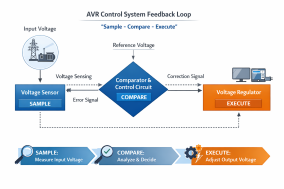
The core of an AVR is a closed-loop feedback control system. Its workflow can be summarized as a continuous cycle of "Sampling - Comparison - Execution - Feedback."
Voltage Sampling & Sensing: Built-in sensors continuously and in real-time monitor the AVR's output voltage.
Error Comparison & Amplification: The detected actual voltage is compared with an internal precision reference voltage source (the setpoint). The voltage deviation (error signal) is calculated and typically sent to a control circuit for amplification and processing.
Regulation Execution: The amplified error signal drives the regulation actuator. Depending on the AVR type, this actuator could be:
·A Servo Motor (in Servo AVRs): Drives a carbon brush to slide along an autotransformer winding, changing the turns ratio.
·A Solid-State Switch Array (in Relay or Electronic AVRs): Controls relays or thyristors (SCRs) to switch between different transformer taps.
·A High-Frequency Inverter (in Double-Conversion Online AVRs/UPS): Reconstructs the output voltage waveform completely using PWM (Pulse Width Modulation) technology.
Output & Feedback: The actuator's movement alters the parameters of the AVR's internal circuit (e.g., transformer ratio), thereby correcting the output voltage to move it closer to the setpoint. The corrected voltage is sampled again, starting a new cycle to achieve dynamic stability.
Based on the regulation mechanism and actuator, mainstream AVRs can be categorized as follows:
Characteristic / Type | Servo-Motor Controlled (SVC AVR) | Relay Tap-Switching | Solid-State Electronic Switching (e.g., IGBT/PWM) |
Core Regulation | Servo motor drives a carbon brush for continuous, brush-based voltage adjustment. | Relays (contactors) switch between transformer taps for stepped, discrete adjustment. | Uses high-frequency PWM to instantly reconstruct a pure sine wave via transistors like IGBTs. |
Regulation Accuracy | High (typically ±1%) | Lower (depends on steps, typically ±5-10%) | Very High (up to ±0.5% to ±1%) |
Response Speed | Slower (~20-50 ms/Volt) | Slow (relay action ~50-100 ms) | Extremely Fast (<1-2 ms, corrects within a cycle) |
Output Waveform | Same as input, may add slight distortion. | Same as input, may have brief interruption during switching. | Clean sine wave, unaffected by input distortion. |
Reliability | Mechanical parts (brush, motor) wear, require maintenance. | Relays have a mechanical lifespan and contact oxidation issues. | No moving parts, high reliability, maintenance-free. |
Typical Loads | General-purpose, for most precision equipment. | Basic equipment with low accuracy/response needs. | Critical equipment (medical imaging, data servers, high-end instruments). |
Cost | Medium | Lower | Higher |
When evaluating and selecting an AVR, these core parameters are essential:
Rated Capacity & Input/Output Voltage Range:
·Capacity: Expressed in VA or kVA, it's the AVR's maximum load-handling capability. It must exceed the total power of all connected loads with a 20-30% safety margin.
·Input Voltage Range: The window within which the AVR operates and regulates (e.g., 140V-260V). A wider range means better adaptability to grid fluctuations.
·Output Voltage: Usually a fixed value (e.g., 220V/110V) or an adjustable range.
Regulation Accuracy & Response Time:
·Regulation Accuracy: The max allowable deviation of output from the rated value (e.g., ±3%). Higher accuracy means better protection.
·Response Time: The maximum time for the AVR to restore output to the stable range after a sudden input or load change. Shorter response time means better transient suppression.
Efficiency & Waveform Distortion:
·Efficiency: Output-to-input power ratio. High efficiency (>95%) means lower energy loss and heat.
·Total Harmonic Distortion (THD): Harmonic content added by the AVR. Lower THD means a cleaner sine wave, better for sensitive electronics.
Overload & Protection Features: A good AVR should include over-voltage, under-voltage, over-current, short-circuit, and over-temperature protection, safely cutting off output or bypassing during faults.

AVRs are vital wherever power quality is critical:
·Industrial Manufacturing: Protects CNC machines, PLCs, industrial robots from voltage swings, ensuring precision and continuity.
·IT & Telecommunications: Provides "clean" power to servers, network gear, and base stations, preventing data loss and hardware damage.
·Healthcare: Ensures absolute stability for MRI, CT scanners, and life-support monitors.
·Commercial/Office: Protects security systems, POS terminals, computers, and precision AC units.
·Residential: Safeguards high-end audio/video systems, smart home hubs, and workstations.
Practical Selection Steps:
·Determine Total Load: Calculate the sum of all protected devices' maximum power (in VA, considering power factor for inductive loads). Add a 20-30% margin for the required AVR capacity.
·Assess Grid Environment: Measure local voltage fluctuation range. Choose an AVR with a wider input voltage range. For extreme/ frequent fluctuations, prioritize types with fast response and high accuracy.
·Identify Load Characteristics:
·For motors, compressors (high inrush current), choose an AVR with strong surge handling and a high inrush current handling capability.
·For computers, servers, lab instruments (waveform/ transient sensitive), prefer Solid-State or Double-Conversion types.
·Evaluate Key Performance: Within budget, prioritize regulation accuracy and response time. Also check efficiency and protection features.
·Consider Installation & Environment: Choose tower or rack-mount based on space. Ensure adequate ventilation.

Digitization & Intelligence: Integration of microprocessors and DSP for precise control, remote monitoring, data logging, and self-diagnostics.
High Frequency & Modularity: Advanced topologies (e.g., high-frequency link) and modular parallel design for higher power density, faster response, and N+X redundancy for critical facilities like data centers.
Wide Frequency/Voltage Adaptation: Development of AVRs that adapt to wider input ranges (e.g., 45-65Hz) for renewable energy integration and special grids.
Energy Efficiency & Green Design: Pursuit of higher full-load efficiency and intelligent energy-saving modes (standby, sleep) to reduce no-load losses.
The Automatic Voltage Regulator (AVR) is a critical solution for improving power quality and protecting electrical equipment from voltage instability. Whether used in residential systems, industrial facilities, or generator applications, AVRs ensure consistent voltage output, enhance equipment reliability, and reduce the risk of power-related failures.
As power demands continue to grow and electrical systems become more sensitive, the role of AVR technology in modern power protection will only become more essential.
Industry Information