
Home > Industry Information > EMI Filter: Introduction, Functions, And Applications
EMI Filters, or Electromagnetic Interference Filters, are indispensable passive networks in modern electronic equipment. Their core mission is to suppress electromagnetic noise bidirectionally: they prevent internally generated noise from contaminating the power grid or interfering with other devices via power or signal lines, while also blocking external interference from the grid or space from entering the device to ensure its stable operation. In short, the EMI filter is the "goalkeeper" that enables electronic devices to meet globally mandatory Electromagnetic Compatibility regulations and achieve reliable functioning.
An EMI filter, short for Electromagnetic Interference Filter, is a circuit or electronic component specifically designed to suppress unwanted electromagnetic noise. Its primary purpose is to reduce the transmission of high-frequency interference, preventing noise from entering sensitive circuits or escaping into other systems, thereby improving overall electromagnetic compatibility (EMC).
Functionally, an EMI filter behaves like a low-pass filter. It significantly attenuates high-frequency interference signals while allowing normal low-frequency operating signals to pass through. This makes EMI filters highly effective in reducing unwanted electrical noise without affecting normal circuit operation.
EMI filters are typically constructed using passive components such as capacitors, inductors, and common-mode chokes. Their operating principles can be summarized as follows:
Capacitors provide a low-impedance path for high-frequency noise, diverting it to ground or a bypass path and preventing it from entering sensitive circuits.
Inductors present high impedance to high-frequency signals, thereby restricting the propagation of interference.
By combining these components, EMI filters strongly attenuate noise signals while having minimal impact on normal power or signal frequencies.
In typical power-line EMI filters, a combination of common-mode chokes and differential-mode capacitors is commonly used. The common-mode choke suppresses common-mode noise (noise flowing in the same direction on multiple conductors), while the capacitors attenuate differential-mode noise (noise appearing between conductors).
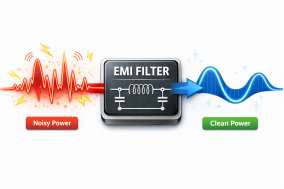
The key functions of EMI filters include:
Suppressing Internal Noise Generated by Equipment:Electronic circuits such as switching power supplies, motor drives, and digital logic generate high-frequency noise during operation. EMI filters reduce the conduction of this noise through power or signal lines.
Preventing External Interference from Entering the System:Power and signal lines can act as antennas that carry external electromagnetic noise. EMI filters help protect sensitive internal circuits from such interference.
Improving Electromagnetic Compatibility (EMC):Many electronic products must comply with strict EMC regulations and standards. By effectively reducing conducted emissions, EMI filters help products pass certification tests more easily and shorten time-to-market.
Enhancing System Stability and Reliability:By minimizing electromagnetic noise, EMI filters reduce the risk of malfunction, data errors, and unexpected system resets, improving long-term reliability.

Based on application and integration level, EMI filters are mainly categorized as follows:
Power Line EMI Filters: The most common and standardized type, used at the power input of equipment. Their typical internal structure clearly demonstrates the collaborative filtering of differential and common-mode noise, as shown in the functional diagram below.
Signal Line EMI Filters: Used for data lines, communication lines (e.g., USB, Ethernet), often in the form of π-type filters, common-mode chokes, or integrated filtered connectors. They primarily suppress high-frequency radiation and induced noise during signal transmission.
PCB Mounted Filters: Filtering circuits directly designed onto the printed circuit board, typically composed of chip beads, chip capacitors, and small common-mode chokes. They are used for local filtering at IC power pins or high-speed digital lines.

The following parameters are critical when selecting and using EMI filters:
Rated Voltage and Current: The maximum supply voltage and maximum continuous current the filter can safely handle long-term. Selection must be based on the equipment's maximum operating conditions with sufficient margin.
Insertion Loss: This is the core metric for evaluating filter performance. It represents the attenuation capability of the filter for noise signals at specific frequencies after insertion, usually expressed in decibels (dB). A higher loss value indicates better filtering performance. Manufacturers typically provide insertion loss curves from 150kHz to 30MHz or even higher frequency bands.
Operating Frequency Range: The frequency interval where the filter is effective, which needs to cover the main interference frequencies the equipment might generate or be sensitive to.
Leakage Current: Due to Y-capacitors connected between Line/Neutral and Earth, a small AC current path is formed, resulting in a tiny leakage current. For applications with strict limits like medical equipment, filters with low leakage current or special designs must be selected.
Safety Approvals: As safety-critical components, filters must have the appropriate safety certifications for the target market, such as UL, cUL, VDE, CQC, and comply with relevant standards (e.g., IEC/EN 60939).
Switch-Mode Power Supplies and Inverters: Suppressing strong noise generated by their high-frequency switching actions.
Motor Drives and Variable Frequency Drives (VFDs): Filtering broadband interference produced during motor operation.
Industrial Automation Equipment: Ensuring the reliability of PLCs, servo systems, etc., in complex electromagnetic environments.
Medical Electronic Equipment: Preventing inter-device interference and meeting extremely strict leakage current and safety standards.
Information Technology Equipment: Ensuring computers, servers, etc., comply with radiation emission standards like FCC and CE.
New Energy Vehicles: Used in high-voltage, high-power components like onboard chargers and motor controllers.
Determine Basic Specifications: Identify the equipment's power type (single/three-phase), rated voltage, and maximum operating current.
Identify Interference Characteristics: Estimate the main frequency range and intensity of interference based on the circuit's nature (e.g., switching frequency).
Check Standards and Approvals: Determine the required EMC standard level and safety certification requirements based on the target market and industry.
Refer to Insertion Loss Curves: Select a filter model with sufficiently high insertion loss values within the target interference frequency band.
Consider Environmental and Mechanical Factors: Evaluate installation space, heat dissipation conditions, connection methods (terminal blocks, screw terminals), etc.

With increasing power density and switching frequencies of equipment, higher demands are placed on EMI filter performance:
Higher Frequency and Broader Bandwidth Operation: Addressing noise challenges in the MHz+ range brought by wide-bandgap semiconductor devices like SiC and GaN.
Integration and Miniaturization: Integrating filters with connectors, fuses, switches, etc., to save space.
High-Performance Magnetic Materials: Using new nanocrystalline or amorphous alloy cores for common-mode chokes to achieve higher impedance and better high-frequency characteristics in smaller volumes.
Simulation and Design Optimization: Utilizing advanced electromagnetic field simulation software for precise design and prediction of filter layout and parameters, achieving performance optimization.
In summary, the EMI filter is a cornerstone technology for achieving electromagnetic compatibility. By strategically combining passive components to attenuate both differential and common-mode noise, it acts as a critical barrier that protects electronic systems from internal and external interference. As electronic systems become faster and more powerful, driving the need for filters with higher performance, wider bandwidth, and smaller size, the role of the EMI filter remains fundamentally vital. Its continuous evolution ensures the reliable and compliant operation of everything from consumer gadgets to industrial machinery and advanced vehicles.
Industry Information