
Home > Industry Information > Thermal Pads Vs. Thermal Paste: A Comprehensive Guide To Thermal Interface Materials
This article provides a detailed comparison between two essential thermal interface materials: thermal pads and thermal paste. It explains their shared purpose of filling microscopic air gaps to improve heat transfer, then delves into their distinct forms, advantages, and limitations. A comprehensive comparison table clearly contrasts their key characteristics in application, performance, and maintenance. Finally, the guide offers practical selection principles and usage tips, recommending specific scenarios for each material to help users make informed decisions based on their specific cooling needs.
Thermal pads are pre-formed solid sheets made from thermally conductive materials such as silicone, graphite, or composite polymers. They are available in various thicknesses and sizes to suit different applications.
Their main function is to bridge larger gaps between components and heat sinks while maintaining reasonable thermal conductivity. Thermal pads are extremely easy to apply—simply place them between surfaces—making them clean, convenient, and beginner-friendly.
Thermal paste (also known as thermal grease or thermal compound) is a semi-fluid material, typically composed of a silicone or synthetic base mixed with thermally conductive fillers such as metal oxides or ceramic particles.
Its key advantage lies in its ability to fill microscopic surface imperfections, maximizing the effective contact area between two surfaces and significantly reducing thermal resistance. When applied correctly, thermal paste delivers excellent heat transfer performance, especially in high heat-density applications.
Before discussing their differences, it's essential to understand their shared mission: filling "micro-gaps."
Ideally, the chip surface and heatsink base would be perfectly flat, smooth metal surfaces that contact each other seamlessly. In reality, however, even under a microscope, metal surfaces have countless tiny, uneven grooves. When two surfaces contact, the actual contact area may be less than 10% of the apparent area. These unfilled gaps contain air, which has extremely poor thermal conductivity, creating significant thermal resistance.
The role of interface thermal materials is to fill these gaps, expel the air, and establish an efficient channel for heat flow. They are typically made by mixing highly thermally conductive solid fillers (such as aluminum oxide, boron nitride, zinc oxide, silver powder) into a polymer matrix (silicone oil, silicone rubber, etc.), achieving a balance between mechanical and thermal properties.
Thermal pads are pre-formed, solid sheet-like thermal materials with a certain thickness and firmness.
Composition and Form: Typically use silicone as a matrix, embedded with thermally conductive fillers, manufactured into sheets or rolls of different thicknesses (e.g., 0.5mm, 1.0mm, 1.5mm, 2.0mm) and hardness (often indicated by Shore 00 scale).
Core Advantages:
·Extremely Easy to Use: Simply cut to the desired shape, peel off the protective film, and place it on the component. No application needed, high consistency, suitable for mass production.
·Ability to Fill Large Gaps: Specifically designed to address height mismatches, for example, creating a thermal path from "shorter" components like memory chips, VRAM, power delivery MOSFETs, or SSD controllers to a heatsink or chassis.
·Insulation and Cushioning: They are good insulators with no risk of short circuits. They also possess some elasticity and compressibility, cushioning against vibration and installation pressure, protecting delicate components.
·Clean and Non-Messy: Usually leave no residue upon disassembly or require only simple cleaning.
Main Disadvantages:
·Relatively Lower Thermal Performance: Due to their solid form, their ability to fill microscopic contact surface irregularities is inferior to high-quality paste, so their thermal conductivity and final thermal resistance are typically higher than paste of the same grade.
·Fixed Thickness: Choosing the wrong thickness can lead to insufficient pressure (if too thick) or crushing damage (if too thin).

Thermal paste, often called "thermal grease" or "heat sink compound," is a paste-like, highly thermally conductive insulating material.
Composition and Form: Primarily made from silicone oil as a carrier mixed with thermally conductive fillers like metal oxides. Its consistency is similar to toothpaste or cream, offering good wettability and deformability.
Core Advantages:
·Ultra-Low Thermal Resistance: Due to its liquid-like properties, when applied correctly (thin and even), it excellently fills microscopic irregularities, achieving the closest possible contact between the chip and heatsink, resulting in the lowest theoretical thermal resistance among the two.
·Suitable for High Heat Flux Density: The optimal choice for core heat-generating components like CPUs and GPUs, capable of handling instantaneous bursts of high heat flux.
Main Disadvantages:
·High Application Difficulty: Requires manual application; too much (causing spillover contamination) or too little (incomplete coverage) severely impacts effectiveness. Common application methods include the "dot," "line," and "cross" methods.
·Pump-Out Effect: Under long-term thermal cycling, the silicone oil may separate from the fillers and migrate out of the contact interface, leading to degraded thermal performance over time.
·Messy Maintenance and Cleaning: When disassembling the heatsink, the paste can contaminate surrounding components, requiring careful cleaning before reapplication.
·Variable Electrical Insulation: While most pastes are insulating, top-tier pastes containing metal fillers (like liquid metal) are conductive, and misuse can cause short circuits.

Feature Dimension | Thermal Pad | Thermal Paste | Analysis & Selection Insight |
Physical Form | Solid, sheet | Paste, semi-fluid | Paste is for near-zero gap tight metal interfaces (e.g., CPU IHS). Pad is for interfaces with significant height differences. |
Core Advantage | Easy application, fills gaps, insulates, cushions | Lowest theoretical thermal resistance, extremely high heat transfer efficiency | Choose high-performance paste for extreme cooling (e.g., overclocking). Pads are better for production efficiency, maintainability, or multi-height components. |
Main Disadvantage | Relatively lower thermal performance, thickness must be chosen precisely | High application skill required, ages (pump-out), can be messy | Paste requires periodic maintenance/replacement (1-3 years). Pad thickness must be chosen precisely based on the measured gap. |
Thermal Conductivity | Common: 1 - 8 W/(m·K) | Common: 5 - 15 W/(m·K) | Higher number usually means better conduction, but real-world effectiveness depends more on application and interface contact. High-performance pads approach mid-range paste. |
Typical Application | Memory chips, VRM, M.2 SSD, chipset heatsinks | Interface between core dies (CPU, GPU) and heatsink | Paste attacks the "high ground" (core). Pads handle the "hills" (peripheral components) and solve "altitude differences". |
Electrical Insulation | Fully Insulating | Most are insulating, but some metal-filled products conductive | In areas with exposed dies or dense capacitors, insulating pads are safer. Extreme caution is needed when using conductive paste (especially liquid metal). |
Lifespan & Maintenance | Stable performance, long lifespan; no replacement unless physically damaged | Performance degrades over time; check/replace every 1-3 years | Paste is a "consumable," pads are more like "parts." |

Consider the Contact Surfaces: If it involves two flat, hard metal surfaces (like a CPU IHS and a copper heatsink base) with minimal gap, prioritize thermal paste for best performance.
Consider the Height Difference: If component heights are inconsistent, or there's a gap of 0.5mm or more between the component and heatsink, you must use a thermal pad of corresponding thickness.
Consider the Application Scenario:
·DIY Enthusiasts, Extreme Overclockers: Choose high-performance paste and learn proper application (thin and even is key).
·General PC Builders, Upgraders: For less hassle, use mid-to-high-end paste on core components; use pads on peripherals.
·Mass Production, OEM Design: Pads are widely used on non-core components due to consistency and advantages in automated assembly. Core CPU/GPU might still use factory-applied paste.
For Thermal Paste:
·"Less is More": A very thin layer that just covers the surface is enough. Too thick actually increases thermal resistance.
·Recommended Method: For a square chip, placing a small pea-sized dot (or a thin line) in the center and letting the heatsink pressure spread it is one simple, effective method.
·Cleaning: Use a lint-free cloth (like a coffee filter) with high-purity isopropyl alcohol (IPA) to clean off old paste thoroughly.
For Thermal Pads:
·Measure Precisely: Use calipers to measure the exact gap between the component top and the heatsink contact surface. Choose a pad with a thickness slightly less than or equal to this gap, relying on compression for good contact.
·Apply Moderate Pressure: Ensure the heatsink applies even pressure on the pad for good contact, but avoid over-tightening which can crush the pad or damage components.
·Protective Film: Always peel off both protective films before use.
When to Choose Thermal Pads:
Large or Uneven Gaps between the component and heat sink
Moderate Heat Output Devices, such as RAM, VRMs, and power management ICs
Ease of Installation and Maintenance is a priority
When to Choose Thermal Paste:
Maximum Cooling Performance is required
High-Power Components, such as CPUs and GPUs
Long-Duration or High-Load Operation, where thermal efficiency is critical
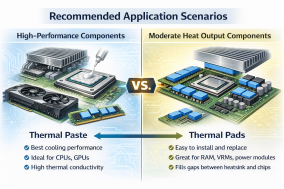
In summary, thermal pads and thermal paste are complementary solutions for thermal management, each excelling in different scenarios. Thermal paste is the optimal choice for achieving maximum heat transfer efficiency between flat, tightly mated surfaces like CPUs and heatsinks. Thermal pads, on the other hand, are ideal for filling larger gaps, providing electrical insulation, and enabling clean, easy installation on components like memory chips and VRMs. The right choice depends on balancing performance requirements, ease of use, and the physical constraints of the application.
Industry Information