
Home > Industry Information > Amplifier Integrated Circuits: Principles, Classification, And Applications
This article outlines Amplifier Integrated Circuits (ICs). It defines their core function of amplifying signals and introduces the key concept of Gain. Amplifiers are primarily classified by their operation class (A, B, AB, C, D), which involves a central trade-off between signal fidelity (linearity) and energy efficiency. The text highlights the advantages of ICs (e.g., small size, consistent performance) and lists crucial selection parameters. Finally, it names major types like the versatile Operational Amplifier and Audio Power Amplifier ICs, underscoring their foundational role in modern electronics.
An amplifier is fundamentally a type of electronic circuit that takes a weak input signal and produces an output signal with a larger amplitude. An amplifier integrated circuit implements this function within a single chip. Compared with amplifier circuits built from discrete components (such as individual transistors, resistors, and capacitors), amplifier ICs offer advantages including smaller size, stable performance, lower power consumption, and reduced manufacturing cost.
The basic purpose of an amplifier IC is to amplify voltage, current, or power, which aligns with the general definition of an amplifier: an electronic device or circuit used to increase the magnitude of an input signal.
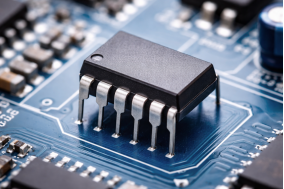
An amplifier is fundamentally a signal enhancement device. It receives a weak input signal (which may come from a sensor, microphone, or other source) and produces an output signal that is significantly increased in magnitude (voltage, current, or power) while maintaining the same waveform characteristics.
The core parameter measuring this enhancement capability is Gain. Gain is the ratio of the output signal quantity to the input signal quantity, a dimensionless number. Depending on the signal type of interest, gain is mainly divided into three categories:
Voltage Gain (Aᵥ): The ratio of output voltage to input voltage. For example, amplifying a 10mV input to a 1V output gives a voltage gain of 100.
Current Gain (Aᵢ): The ratio of output current to input current.
Power Gain (Aₚ): The ratio of output power to input power. It equals the product of voltage gain and current gain.
In engineering, gain is often expressed in decibels (dB), a logarithmic scale convenient for representing vast ranges of change and simplifying the calculation of total gain for multi-stage amplifiers (converting multiplication to addition). The conversion formulas are:
Voltage/Current Gain (dB): G = 20 * log₁₀(Linear Gain Value)
Power Gain (dB): G = 10 * log₁₀(Linear Gain Value)

Amplifiers can be classified in various ways. Integrated circuit design selects the appropriate type based on different application goals.
Classification | Signal Characteristics | Primary Design Goal | Typical Applications |
Small-Signal Amplifier | Microvolt (µV) to millivolt (mV) level | High gain, low noise, high linearity | Sensor pre-amplification, RF reception, microphone pre-amplification |
Large-Signal / Power Amplifier | Volt (V) level, high current | High-efficiency output power, low distortion | Audio power amps driving speakers, motor drives, transmitter final stages |
3.2Classification by Bias Point (Amplifier Class)
This is one of the most important classifications for amplifiers, directly determining the trade-off between efficiency and linearity. It is based on the conduction state of the output transistor(s) over one full cycle of the input signal.
Class | Conduction Angle | Max Theoretical Efficiency | Characteristics & Trade-off | Typical Application Scenarios |
Class A | 360° (Always ON) | ≤ 25% (resistive load) | Excellent linearity, lowest distortion; but very low efficiency, high quiescent power dissipation. | High-fidelity audio pre-amplifiers, instrumentation |
Class B | 180° (Half cycle) | ≈ 78.5% | Uses two transistors in push-pull configuration, higher efficiency; but suffers from "crossover distortion". | Older audio power amps (largely replaced by AB) |
Class AB | Between 180° & 360° | Between Class A & B | Compromise between linearity & efficiency, eliminates crossover distortion via small bias. | Mainstream audio power amplifiers |
Class C | < 180° | Can exceed 80% | Highest efficiency; but output distortion is very high, nonlinear. | RF transmitters, tuned resonant circuit amplification |
Class D | Switching Mode (Digital) | Can exceed 90% | Transistors operate as switches, very high efficiency; requires filtering to reconstruct analog waveform. | Modern portable audio amps, motor drives |
Efficiency (η) is defined as the useful AC signal power delivered to the load divided by the total DC power drawn from the supply. The ideal amplifier efficiency is 100%, but in practice, factors like transistor voltage drop and heat loss keep efficiency below the theoretical maximum.

Integrating amplifier circuits provides revolutionary advantages:
Miniaturization & High Density: Integrates numerous transistors, resistors, etc., onto a millimeter-scale chip.
Excellent Consistency: Chips from the same wafer have highly consistent parameters, eliminating the tedious tuning of discrete circuits.
Optimized Performance: Enables precisely matched internal structures like differential pairs and current mirrors, improving key metrics like Common-Mode Rejection Ratio (CMRR) and Power Supply Rejection Ratio (PSRR).
Built-in Protection: Can integrate over-temperature, over-current, and short-circuit protection, enhancing reliability.
Cost Reduction: Mass production makes individual chip costs very low.
When designing or selecting an amplifier IC, in addition to gain, class, and efficiency, the following parameters are crucial:
Bandwidth & Slew Rate: Determine the amplifier's ability to handle high-frequency signals.
Input Offset Voltage: Affects DC accuracy.
Noise Density: Determines how weak a useful signal can be amplified.
Input/Output Impedance: Related to matching with preceding and following circuit stages.
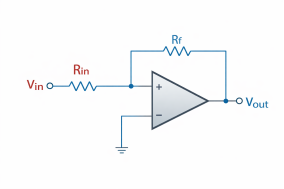
Operational Amplifier (Op-Amp): The most versatile analog IC, essentially a high-gain DC-coupled voltage amplifier IC. Configured with external feedback networks, it can form countless circuits for amplification, filtering, comparison, integration, etc., forming the cornerstone of analog signal processing.
Audio Power Amplifier IC: Such as Class AB or Class D audio power amp chips, widely used in phones, speakers, TVs, etc., to directly drive loudspeakers.
Radio Frequency (RF) Amplifier IC: Includes Low-Noise Amplifiers (LNA), Power Amplifiers (PA), etc., operating at high radio frequencies for wireless devices like phones, Wi-Fi, and Bluetooth.
Instrumentation Amplifier: A specialized precision IC for amplifying weak differential signals (e.g., from bridge sensors), featuring very high input impedance and common-mode rejection ratio.
From basic A-class amplifiers to efficient D-class switching amplifiers, from small signal amplifiers that handle weak signals to power amplifiers that drive loads, amplifier integrated circuits have permeated every corner of the modern electronics industry. Understanding its classification, principles, and key parameters is a prerequisite for correctly selecting and designing electronic systems. With the advancement of semiconductor technology, amplifier ICs are constantly developing towards higher frequencies, lower power consumption, and greater intelligence (integrated digital control and calibration), continuously driving innovation in electronic devices.
Industry Information