
Home > Industry Information > A Detailed Look At Pin Connectors
This document provides a comprehensive overview of pin connectors, detailing their definition, "male-female" structure, and core classifications by mounting method, form factor, and pitch. It explains key performance parameters for selection and highlights their widespread applications across industries like consumer electronics, automotive, and telecommunications. The passage concludes by outlining future trends toward miniaturization, high-speed performance, and enhanced reliability.
Pin connectors are a widely used class of connectors in the electronics and electrical fields. Their core component consists of one or multiple metal pins designed to mate with corresponding sockets to complete electrical connections and signal transmission. The main purpose of pin connectors is to safely and reliably link various electronic components, circuits, or devices, enabling power delivery or data communication.
A pin connector typically consists of a male pin and a female socket:
Male pin: exposed metal pins used for insertion.
Female socket: holes that accept and match the male pins.
This “male–female” structure prevents incorrect mating and ensures stable electrical contact.
Structurally, pins can be soldered directly onto a PCB (printed circuit board) or connected to wires through crimping or pin blocks.

The basic composition of a pin connector typically includes two parts: the plug (male header, with pins) and the socket (female header, with receptacles). Its defining feature is the use of one or multiple rows of rigid cylindrical or square metal pins. They can be primarily classified from the following dimensions:
2.2.1By Mounting Method
Through-Hole (THT): Pins are inserted through drilled holes in the printed circuit board and then soldered. This offers high connection strength and durability, common in applications requiring mechanical stability.
Surface-Mount (SMT): Pins are soldered onto the surface of the PCB. This is suitable for automated production, saves internal board space, and is mainstream in modern high-density electronic devices.
2.2.2By Pin Arrangement and Form Factor
Single/Dual Row Headers: The simplest structure, low cost, widely used for general-purpose board-to-board or board-to-cable connections.
D-Sub Connector: A classic trapezoidal metal-shell connector named by pin count (e.g., DB9, DB25). Once common for serial communication and video interfaces, now more prevalent in industrial fields.
Box Header/IDC Connector: The socket has plastic latches on both sides that lock with the plug, effectively preventing disconnection due to vibration. Commonly found in interfaces like older IDE hard drive cables.
Board-to-Board (B2B) Connector: Specifically designed for vertical or parallel stacking of two PCBs in extremely narrow spaces. They feature very fine pin pitches and are critical components in compact devices like phones and tablets.
2.2.3By Pin Pitch
Pin pitch is a key parameter of a connector, directly affecting connection density. Common standard pitches include 2.54mm, 2.0mm, 1.27mm, 1.0mm, 0.8mm, and 0.5mm. Smaller pitches allow for higher integration but place stricter demands on manufacturing precision and alignment during mating. High-density headers can achieve pitches as fine as 0.5mm or even 0.3mm.

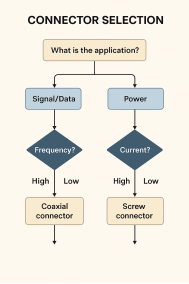
Selecting the right pin connector requires a comprehensive evaluation of the following core parameters:
Core Selection Philosophy: There is no "best" connector, only the "most suitable" one. The optimal balance must be struck between electrical requirements, mechanical space, environmental conditions, reliability, and cost.
Pin connector applications cover all fields of the electronics industry:
Consumer Electronics: Board-to-board connectors in phones connect the mainboard to displays and cameras; connectors inside computers link power supplies, USB ports, audio modules, etc.
Industrial Control & Automation: PLC modules, industrial sensors, and motor drives widely use D-Sub, box headers, and industrial connectors with screw locks, emphasizing reliability and vibration resistance.
Automotive Electronics: Special automotive-grade connectors are used in ECUs, wiring harnesses, and infotainment systems, requiring high vibration tolerance, wide-temperature operation, and high reliability.
Telecom/Data Communication: High-speed connectors on network router and switch backplanes transmit differential signals, demanding excellent signal integrity and shielding. The communication field is a major application area, accounting for about 23.8% of the connector market.
Medical Devices & Aerospace: In these high-reliability fields, connectors must meet additional stringent standards, such as biocompatibility, high purity, or radiation-resistant properties.
As electronic devices continue evolving towards miniaturization, high performance, and high reliability, pin connector technology also shows clear trends:
High Density & Miniaturization: Pin pitch continues to shrink, integrating more contacts in a smaller volume. Connector spacing is being pushed to ultra-fine levels like 0.3mm and even 0.2mm.
High Speed & High Frequency: To meet 5G and high-speed data transmission demands, connector design increasingly focuses on impedance matching, crosstalk control, and shielding effectiveness, evolving towards "signal integrity" design. Next-generation standards like 224G PAM4 are already in development for AI servers.
High Reliability & Robustness: Requirements for consistency of mating force, contact stability, and tolerance in harsh environments (e.g., high temperature, humidity) are increasing.
Material Innovation & Intelligence: The adoption of new materials like Silicon Carbide (SiC) enables connectors to withstand extreme temperatures up to 300°C. There is also a trend towards "smart connectors" with integrated functions like status monitoring and fault prediction.
In conclusion, pin connectors are essential components for reliable electrical connections in modern electronics. Selecting the right connector requires balancing electrical needs, mechanical constraints, environmental conditions, and cost. As technology advances, the evolution of pin connectors is driven by demands for higher density, faster data transmission, and greater robustness in increasingly compact and complex devices.
Industry Information