
Home > Industry Information > Toroidal Transformer: The Heart Of Efficient Power Conversion
This article introduces the Toroidal Transformer, emphasizing its unique ring-shaped core that enables superior performance including high efficiency, compact size, and low noise. It covers the transformer's working principle, key advantages over traditional types, main categories, and widespread applications in audio, medical, and industrial fields, concluding with its promising market prospects driven by energy efficiency demands.
A Toroidal Transformer is a type of transformer whose core is shaped like a ring (similar to a doughnut). The primary and secondary windings are uniformly wound around this toroidal core. Compared with traditional E- or I-shaped laminated transformers, this closed magnetic-loop structure offers significant advantages in energy transfer efficiency.

The working principle of a toroidal transformer is based on Faraday's law of electromagnetic induction. When an alternating voltage is applied to the primary winding, an alternating current flows through the conductor, creating an alternating magnetic flux.
This magnetic flux travels through the core, linking the primary and secondary windings to form a closed magnetic circuit, thereby inducing a mutual electromotive force in the secondary winding.
Unlike laminated transformers, the continuous magnetic path of the toroidal transformer allows for more efficient magnetic coupling.
During no-load operation, a certain current—the no-load current—still exists in the primary winding. However, the no-load current of a toroidal transformer is only 10% of that of a laminated transformer, meaning lower energy consumption in standby mode.
When a load is connected to the secondary winding, the current flowing in the secondary winding produces a counter magnetic flux, partially canceling the primary magnetic flux.
This causes the primary current to increase accordingly, maintaining the total magnetic flux in the core essentially constant and enabling efficient energy transfer

The core of a toroidal transformer lies in its unique core design. It uses high-quality cold-rolled silicon steel strips, with a thickness not exceeding 0.35mm, coiled seamlessly.
This continuous magnetic path structure eliminates the air gaps between the laminations found in traditional transformers, significantly reducing magnetic reluctance.
The windings are evenly wound around the toroidal core, causing the magnetic field generated by the coil to align almost perfectly with the core's magnetic path.
This design reduces excitation energy and core losses by 25% compared to laminated transformers.
During manufacturing, vacuum impregnation technology is used to solidify the core structure, making it a solid unit that is less prone to deformation during winding and processing, further minimizing vibration and audible noise.
Toroidal transformers are primarily mounted using their central hole, which is compatible with printed circuit boards, simplifying the installation process.

Toroidal transformers significantly outperform traditional laminated transformers in several key parameters.
Their power conversion efficiency can exceed 95%, far surpassing the ~80% level of traditional transformers. The core stacking factor reaches over 95%, and the no-load current is small.
The volume and weight of a toroidal transformer are 25-50% less than a traditional transformer of the same power rating, a feature highly valuable in the trend towards miniaturization of modern electronic devices.
Because the core has no air gaps and uses a seamless coiled structure, toroidal transformers operate with significantly reduced vibration and noise. Noise levels can be controlled to 30-40 dB, making them ideal for applications requiring quiet operation.
Toroidal transformers also exhibit a low stray magnetic field, resulting in less magnetic interference. They can be used in highly sensitive electronic equipment without additional shielding.
Their operating temperature is lower. The temperature rise of a standard toroidal transformer under full load is only 40°C, and even at 120% overload, the temperature rise does not exceed 70°C.

Based on application requirements, toroidal transformers can be divided into three main categories.
Standard Type:Capacity range: 8-1500VA; Low voltage regulation, temperature rise under full load controlled within 40°C; Allows short-term overload operation; Insulation between windings uses Class B (130°C) polyester film; Withstands Hi-Pot test of 4000V AC for 1 minute.
Economy Type:Capacity range: 50-1500VA; Cost-optimized while maintaining basic performance, suitable for continuous, non-overloading operation; Operating temperature rise is 60°C, using Class A (105°C) insulation; Output voltage error less than 3% at full load.
Isolation Type:Capacity range: 50-1000VA; Includes series for industrial use and medical equipment; Medical-grade isolation transformers must comply with standards like UL544; Feature thermal protection and enhanced safety isolation, such as grounded copper shields between windings.
Thanks to their excellent characteristics, toroidal transformers play important roles in multiple fields.
High-Fidelity Audio Equipment:The low noise and low interference ensure pure sound quality, making them the top choice for high-end audio systems.
Medical Equipment: Critical for safety and stability. Isolation-type transformers effectively prevent micro-shock risks, used in patient monitors, diagnostic, and therapeutic devices.
Industrial Control:Used in CNC machinery and automation control systems. Their high reliability and small size improve system integration.
Power Systems and Solar Inverters:Benefit from the high efficiency of toroidal transformers, enhancing overall energy conversion efficiency.
They are also widely used in quartz lighting, computer systems, and telecommunications instrumentation.
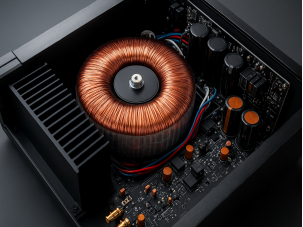
Designing with toroidal transformers requires considering several factors for optimal performance.
Power Capacity:The main determinant of core size. For intermittent loads, the rated power can be calculated based on the duty cycle, potentially reducing size and weight.
Voltage Regulation:A key metric indicating the change in output voltage from no-load to full-load. It improves with increasing transformer capacity.
Capacity Selection:200VA-500VA mid-range transformers offer the best cost-performance ratio compared to laminated types.
Inrush Current:A special consideration. Due to the lack of air gaps and high permeability, toroidal transformers can have higher inrush currents during switch-on.
Below 300VA, standard fuses (8-10 times primary current) can be used.
Higher capacities require slow-blow fuses or thermal cutoffs.
Rectifier Circuits:When used with circuits like bridge or center-tap rectifiers, secondary voltage and current must be calculated appropriately.
The toroidal transformer market shows steady growth. In 2023, the market size in China alone reached RMB 23.09 billion.
Driven by policies like the "Large-Scale Equipment Renewal Action Plan," China's toroidal transformer output is projected to exceed 2 billion units by 2025.
With the growth of new energy, smart grids, and high-end manufacturing, the demand for efficient, energy-saving, and compact transformers will continue to rise, potentially increasing the market share of toroidal transformers.
Technological innovation will also push toroidal transformers towards higher efficiency, smaller size, and lower cost.
Advances in toroidal transformer technology are driving electronic equipment towards higher efficiency, energy savings, and miniaturization, playing a key role in the energy transition.With ongoing innovation and expanding applications, toroidal transformers are poised to replace traditional transformers in more industrial and consumer electronic fields, becoming the core choice for power conversion systems.Their characteristics of low noise, low loss, and high efficiency align perfectly with global sustainability goals.
In summary, the toroidal transformer is a superior power conversion solution, renowned for its high efficiency, compact design, and quiet operation. Its unique structural advantages make it ideal for demanding applications in audio, medical, and industrial sectors. As global emphasis on energy efficiency and sustainability grows, the toroidal transformer is poised to play an increasingly vital role in future electronic systems, solidifying its position as a core component in advanced power conversion technology.
Industry Information