
Home > Industry Information > VHDL: Architect's Language For The Digital World
This passage provides a concise overview of VHDL, positioning it as a fundamental hardware description language crucial for designing modern digital circuits. It explains VHDL's core purpose of describing hardware behavior and structure, highlighting its key characteristics of concurrency, timing, and modularity.
VHDL stands for VHSIC Hardware Description Language, where VHSIC itself stands for Very High-Speed Integrated Circuit. As the name suggests, it was born from a project initiated by the U.S. Department of Defense in the 1980s. The initial goal was to standardize and manage the integrated circuits designed by its contractors, ensuring design portability, reusability, and reliability. In 1987, VHDL was standardized by the IEEE as IEEE 1076, and it has since become one of the two mainstream languages in the Electronic Design Automation (EDA) field (the other being Verilog).
Unlike familiar software programming languages like C++ or Python, the core of VHDL is "description" rather than "execution." Its primary task is to model the behavior and structure of digital circuits.
Software Languages: Describe a sequence of instructions executed sequentially on a CPU.
VHDL: Describes an electronic circuit where multiple logic gates, registers, and signal lines work in parallel.

To understand VHDL, one must grasp its fundamental characteristics:
2.2.1Concurrency
This is the most essential difference between hardware description languages and software programming languages. In real hardware, all circuit components can work simultaneously as long as they are powered. Statements in VHDL code like process and signal assignment are executed concurrently during simulation; their written order does not determine their execution order. This accurately reflects the reality of parallel hardware operation.
2.2.2Timing
The state of a digital circuit changes driven by clock signals. VHDL strongly emphasizes the concept of timing, allowing for precise description of behaviors triggered by clock edges (rising or falling) and delays in signal transmission paths. This enables designers to analyze and ensure the circuit operates stably at a specified frequency.
2.2.3Hierarchy and Modularity
Complex systems can be broken down into smaller, single-function modules (in VHDL, called entity and architecture). These modules can be designed and tested independently and then combined like building blocks to form larger systems. This greatly enhances code reusability and maintainability.
2.2.4Three Levels of Abstraction
Behavioral Level: Focuses on the circuit's function and algorithm, without involving specific hardware implementation. It's like describing "what this module does."
Dataflow Level: Describes the flow and transformation of data between registers, using concurrent signal assignment statements.
Structural Level: Describes which sub-modules the circuit is composed of and the connections between them, much like drawing a circuit schematic.

Developing a chip or FPGA using VHDL typically follows a standard flow:
Design Entry:Writing VHDL code using a text editor to define the interfaces and behavior of various modules.
Functional Simulation:Testing the code using specialized simulation tools (like ModelSim, VCS) to verify if the logic is correct. Timing delays are not considered at this stage.
Logic Synthesis:Using synthesis tools (like Synopsys Design Compiler, Xilinx Vivado) to "translate" the high-level VHDL code into a gate-level netlist corresponding to the target technology library (e.g., LUTs & FFs for FPGAs, or standard cells for ASICs). This is the crucial step of turning ideas into actual circuits.
Place and Route:Mapping the synthesized gate-level netlist onto the physical layout of the specific chip and connecting all the wires.
Timing Simulation:After place and route, extracting more accurate wire delay information and performing simulation again to verify that the circuit works correctly under real timing constraints.
Programming and Download:Finally, downloading the generated configuration file to an FPGA or delivering it to the chip manufacturer for fabrication.
Let's feel the syntax of VHDL with a simplest example of an AND gate.
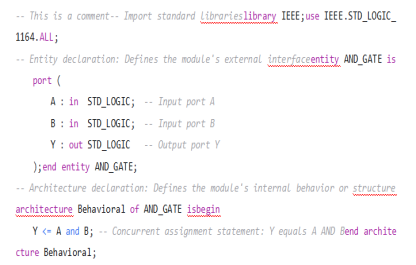
In this example:
The entity defines that the AND gate has two inputs, A and B, and one output Y.
The architecture describes its behavior: the output Y is always equal to the logical AND operation of inputs A and B. This is a typical dataflow description.
This is a common question for beginners. Both are powerful hardware description languages, but they differ slightly in style and application:
Syntax Style: VHDL has rigorous syntax, strict type checking, and is more like Ada or Pascal, helping designers find errors early. Verilog syntax is closer to C language, relatively concise and flexible.
Application Areas: Traditionally, VHDL was more popular in Europe and defense, while Verilog was more prevalent in commercial sectors in North America and Asia. However, as toolchains have improved, their functionalities have become very similar. A skilled designer often needs to master both.
System-Level Design: Both are evolving towards higher-level system modeling through languages like SystemVerilog (an extension of Verilog) and SystemC.
VHDL is not just a programming language; it is a complete methodology for digital system design and verification. It has transformed the design of complex integrated circuits from an art into a predictable and manageable engineering discipline. Although recent technologies like High-Level Synthesis (HLS) attempt to allow designers to work with more abstract languages (like C/C++), VHDL's position as the foundation for underlying description and verification remains unshakable.For anyone wishing to enter the fields of digital circuit design, FPGA development, or ASIC design, mastering VHDL is an extremely valuable and indispensable core skill. It is your bridge to communicate with the world of silicon chips, the starting point for becoming an architect of the digital world.
Industry Information