
Home > Industry Information > Battery Current Sensors: The Essential Guardian For Battery Safety And Performance
This passage offers a concise overview of battery current sensors, essential components for monitoring and protecting batteries in applications like electric vehicles and electronics. It explains their working principle based on the Hall Effect, introduces the two main types (Hall-Effect and Shunt Sensors), and outlines their core functions in safety and performance. The article also covers their key applications and concludes with future trends towards higher integration and precision.
A Battery Current Sensor is an indispensable component in modern electronic devices and electric vehicles, ensuring battery safety and optimizing performance through precise current monitoring. The table below summarizes the core information about battery current sensors for a quick overview of their working principles, types, and key applications.
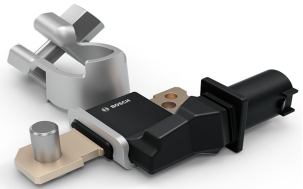
Aspect | Details |
Working Principle | Based on the Hall Effect, it measures current by sensing the magnetic field generated by the current, enabling electrically isolated measurement. |
Main Types | Hall-Effect Sensor: Non-contact measurement, strong anti-interference, ideal for high-current scenarios. |
Core Functions | - Current Monitoring: Real-time measurement of charge/discharge current to prevent overcurrent damage. |
Typical Applications | Electric Vehicle BMS, Energy Storage Systems, Industrial Battery Cabinets, Consumer Electronics Battery Management. |

The core of a battery current sensor is based on sensing the magnetic field via the Hall Effect. When current flows through a conductor, it generates a magnetic field proportional to the current's strength. The Hall sensor accurately captures this magnetic signal and converts it into a proportional voltage output. This method provides electrical isolation between the measured circuit and the detection circuit, ensuring high safety.
They are primarily categorized into two types:
Hall-Effect Current Sensors: This is the most dominant type, holding about 65% of the market share. They are further divided into Open-Loop and Closed-Loop configurations. Open-loop sensors are more compact, have lower power consumption, and are cost-effective, making them widely used in battery monitoring systems.
Shunt Current Sensors: This method involves passing the current through a precision shunt resistor and calculating the current value by measuring the voltage drop across it (Ohm's Law). It is a form of direct measurement.

The data collected by the battery current sensor is crucial for the Battery Management System (BMS), primarily in three areas:
Real-Time Monitoring & Protection: The sensor continuously measures the battery's charge and discharge currents, allowing the BMS to prevent damage caused by excessive current.
State of Charge (SoC) Estimation: By integrating the current over time, the system can calculate the net charge transferred, enabling accurate estimation of the battery's remaining capacity. This is key to preventing overcharging or over-discharging, which can severely impact battery lifespan.
Battery Health Diagnosis: By analyzing charging characteristics and performance, the current sensor can help determine the battery's state of health and usage cycles, prompting the user to replace degraded batteries.
Battery current sensors are essential in a wide range of applications, particularly in:
Electric Vehicles (EVs): This is one of the largest application markets today. High-precision current measurement in an EV's BMS is central to accurate battery protection and improving range estimation. Market forecasts predict that global sales of current sensors for EV batteries will reach ¥5.436 billion by 2031.
Industrial & Energy Storage: In battery cabinets for power plants, communication base stations, and energy storage systems, Hall-effect sensors are used to monitor current in multiple branches, ensuring operational reliability.
Consumer Electronics & Small Devices: Reliable current monitoring is equally critical for safety and performance in products like power tools, vacuum cleaners, and e-bikes.
Globally, key manufacturers in this market include LEM Holding SA, Allegro Microsystems, Melexis, TDK Micronas, Honeywell, and automotive suppliers like Bosch and Denso. The top three companies hold approximately 45% of the market share.

As electrification accelerates, battery current sensor technology continues to evolve, with future trends pointing towards:
Higher Accuracy & Reliability: To maximize the driving range of EVs, demands for sensor precision are becoming increasingly stringent. For example, LEM's CAB 1500 sensor offers best-in-class resolution as low as 0.1%, with low offset and high accuracy.
Functional Safety & Integration: New sensor products are increasingly designed to comply with automotive functional safety standards like ISO 26262 and integrate digital communication interfaces like CAN for easier system integration.
Multi-Parameter Sensing: The market is shifting towards multi-parameter sensors that integrate voltage, current, and temperature sensing into a single, compact unit. This provides more precise measurements and real-time diagnostics.
In summary, the battery current sensor is far more than a simple component; it is the unsung guardian of modern battery systems. From powering our electric vehicles to ensuring the reliability of large-scale energy storage and everyday consumer electronics, this sensor provides the critical data necessary for intelligent battery management. By enabling precise monitoring, accurate charge estimation, and robust safety protection, it directly contributes to the performance, longevity, and safety of the technologies we increasingly rely on. As the world continues its rapid transition towards electrification, the evolution of battery current sensors—driven by demands for greater precision, integration, and intelligence—will remain a cornerstone in the development of more efficient, reliable, and powerful energy solutions for the future.
Industry Information