
Home > Industry Information > Ferrite Bead:The Electromagnetic Interference "Firewall" For Electronic Devices
This passage is a concise guide to Ferrite Beads, key components for suppressing high-frequency electromagnetic noise in circuits. It explains how they work by dissipating noise as heat, contrasts them with inductors, and outlines their primary applications in filtering power and signal lines. The core focus is on providing the essential knowledge for selecting the right bead based on key parameters like impedance and current rating to ensure effective circuit design and EMI control.
A Ferrite Bead is an anti-interference component made primarily from ferrite material, typically cylindrical or surface-mounted in appearance. Its main constituents are iron-magnesium or iron-nickel alloys, which share manufacturing processes and mechanical properties similar to ceramics and exhibit a gray-black color.
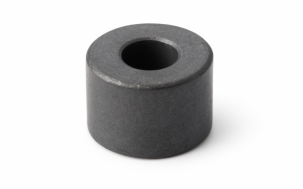
The working principle of a Ferrite Bead is based on its unique frequency-impedance characteristics:
Low-Frequency Performance: Allows low-frequency signals to pass through with minimal attenuation, presenting very low impedance.
High-Frequency Performance: Presents high impedance to high-frequency currents, absorbing electromagnetic interference (EMI) and converting it into heat.
The equivalent circuit of a Ferrite Bead can be simplified as a series connection of an inductor (L) and a resistor (R), with both L and R values varying with frequency. At low frequencies, impedance is mainly inductive; at high frequencies, the resistive component dominates.

Understanding the datasheet is crucial for correct selection. Here are the core parameters:
Rated Impedance:Measured in Ohms (Ω), typically specified at 100MHz (e.g., 600R@100MHz). Select a bead with high impedance in the target noise frequency band.
Frequency Response:Specific ferrite materials have optimal suppression frequency ranges. Refer to the manufacturer's frequency-impedance graph.
DC Resistance (DCR):The bead's resistance under DC conditions. High DCR causes voltage drop and power loss in power circuits.
Rated Current:Maximum continuous current the bead can handle. Derate by typically 80% in practice; consider heat dissipation for high currents.
Saturation Current:Excessive DC current causes magnetic saturation, reducing permeability & performance. Use beads specifically designed for high current scenarios.
Furthermore, based on Q-factor (Quality Factor), Ferrite Beads can be classified into:
High-Q Beads: Typically used as resonators, not suitable for power isolation circuits.
Low-Q Beads (Absorptive Beads): Possess lossy characteristics, forming good filter networks designed to absorb and dissipate high-frequency noise as heat.
Characteristic | Ferrite Bead | Inductor |
| Nature | Energy Conversion (Dissipation) Device | Energy Storage Element |
| Working Mechanism | Absorbs high-frequency noise and converts it to heat | Stores and releases energy |
| Primary Application | Signal lines, EMI suppression | Power filter circuits, energy storage |
| Frequency Focus | Absorption of ultra-high frequencies | Generally below 50MHz |
| Equivalent Circuit | Inductor & Resistor in series | Primarily inductive |
In essence, an inductor reflects unwanted energy, while a bead absorbs it as heat, dictating their distinct application scenarios.

Power Line Filtering:Placing a bead at the power entry point of a PCB effectively filters high-frequency noise, especially crucial in switch-mode power supplies.
Signal Line Noise Suppression:Beads can filter noise on signal cables, suppressing high-frequency harmonics from digital pulse signals that are a primary source of EMI.
Differential & Common Mode Noise Suppression:
For differential mode noise, ensure the bead's current rating is sufficient to avoid saturation.
For common mode noise, pass both power/return lines through the bead/core, presenting high impedance to common-mode signals.
High-Frequency Circuit Isolation:Used in RF circuits, high-speed memory power inputs to absorb UHF signals and prevent inter-circuit interference.

Correct selection is key to ensuring effective performance:
Identify Noise Frequency:Analyze the target noise frequency band and select a bead with high impedance in that range.
Current Requirements:Ensure the rated current significantly exceeds the operating current, as inductance degrades with increased load current.
DC Voltage Drop:Calculate the voltage drop (I_load * DCR) and ensure it's acceptable for the circuit.
Avoid Saturation:Be aware of saturation due to DC bias; beads with larger cross-sections generally handle higher bias currents.
Placement:Place ferrite beads close to the noise source. They are more effective in low-impedance circuits. Multiple turns through a bead increase inductance but can be less effective at very high frequencies.
Thermal Considerations:Optimize heat dissipation in high-current applications to prevent overheating and performance degradation.

Beyond basic uses, consider these techniques:
Multi-Hole Beads:Passing the wire through multiple times increases impedance (roughly proportional to the square of the number of turns), though effectiveness diminishes at very high frequencies.
Series Connection: For high-frequency suppression, connecting several beads in series is often more effective than multiple passes through a single bead.
No Ground Required: Unlike capacitor filters, beads dissipate energy as heat and don't require a ground connection, simplifying installation.
Enhanced Shielding: Passing both conductors of a differential pair through a bead confines magnetic fields and provides some electric field shielding.
The Ferrite Bead, a simple yet effective EMI suppression component, plays an indispensable role in today's dense electronic environments. By deeply understanding its principles, characteristics, and application essentials, engineers can precisely deploy beads in circuit design to effectively solve EMI problems, enhancing device performance and stability. As electronics continue trending towards miniaturization and higher performance, Ferrite Beads are expected to find even broader applications, continually supporting the advancement of the electronics industry. Mastering this small yet powerful component adds a reliable layer of "electromagnetic security" to your electronic designs.
Industry Information