
Home > Industry Information > Introduction To Filters In Electronic Components
This passage focuses on filters as critical electronic components,systematically unpacking their fundamental concepts,key attributes, and practical values.It first clarifies what a filter is in the context of electronic systems.Subsequently,it categorizes filters based on criteria relevant to electronic applications and details their specific use cases across major electronic fields.Finally, it summarizes the indispensable role of filters in electronic components.
2.1What is a filter
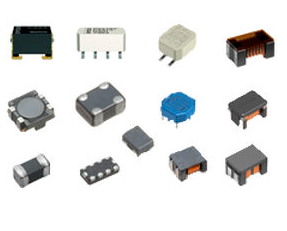
In electronic components, a filter is a specialized circuit or device designed to process electrical signals by selectively allowing specific frequency components to pass through while attenuating or blocking unwanted frequency components.Typically constructed from electronic components like resistors (R),capacitors (C),inductors (L), and operational amplifiers (for active types),filters act as "signal gatekeepers" in electronic systems.
2.2Characteristics
Frequency Selectivity:The most defining characteristic of electronic filters, referring to their ability to distinguish between desired and unwanted frequency signals. Measured by the roll-off rate,a steeper roll-off rate means faster attenuation of stopband signals.
Insertion Loss:The attenuation of desired signals as they pass through the filter, expressed in decibels (dB). Ideal electronic filters exhibit low insertion loss to preserve signal strength. A quality audio filter, for example, maintains insertion loss below 1 dB, ensuring the original sound quality remains uncompromised while filtering out background noise.
Stopband Attenuation:The degree to which unwanted signals in the stopband are weakened. Higher stopband attenuation indicates stronger interference suppression. In medical electronic devices like ECG monitors, filters require stopband attenuation of at least 60 dB to block 50/60 Hz power frequency interference, ensuring accurate detection of weak heart signals.
Environmental Stability:The ability of electronic filters to maintain consistent performance under varying environmental conditions.Industrial-grade filters.
2.3Advantage
Signal Purification:By removing noise and interference, filters enhance the clarity and reliability of electronic signals.In data transmission circuits,filters eliminate high-frequency electromagnetic interference (EMI),reducing data error rates from 10⁻⁶ to 10⁻¹² and ensuring smooth information exchange.
System Compatibility:In complex electronic systems,filters prevent mutual interference between components. For example, a filter in a car’s infotainment system blocks noise from the engine control unit (ECU), ensuring the radio and navigation functions work without disruption.
Component Protection:Stable, filtered signals reduce stress on sensitive electronic components.A power supply filter, for instance, suppresses voltage spikes, extending the lifespan of microprocessors in laptops by up to 30% compared to unfiltered power supplies.
Design Flexibility: Available in compact sizes and customizable configurations, filters adapt to diverse electronic design needs.This flexibility enables their integration into miniaturized devices like wearables and IoT sensors, where space is at a premium.
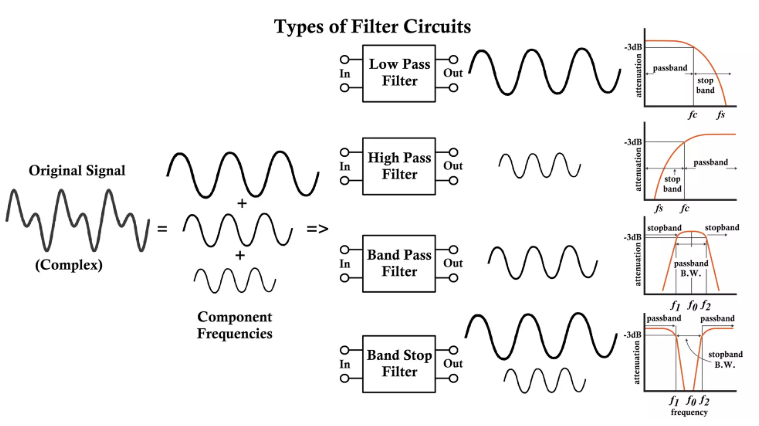
3.1By Passband Frequency (Electronic-focused):
Low-Pass Filter (LPF):Allows frequencies below a cutoff value to pass, blocking higher frequencies. Widely used in power supplies to filter AC ripple from DC output and in audio circuits to send low-frequency signals to subwoofers.
High-Pass Filter (HPF):Permits frequencies above the cutoff value, attenuating lower frequencies. Common in audio systems to direct high-frequency signals to tweeters and in communication circuits to filter out low-frequency hum.
Band-Pass Filter (BPF):Transmits only signals within a specific frequency range. Essential in RF receivers to select target channels and in medical electronics to isolate brain wave signals (0.5–30 Hz).
Band-Stop Filter (BSF/Notch Filter):Blocks a narrow range of frequencies while passing others.Used to suppress specific interference, such as 50/60 Hz power noise in measurement equipment or harmonic distortion in power inverters.
3.2By Component Composition:
Passive Filter:Constructed from passive components (R, C, L) with no external power required. Advantages include low cost, simple structure, and high reliability; limitations include moderate frequency selectivity and higher insertion loss. Suitable for basic applications like consumer electronics power filtering and simple audio circuits.
Active Filter:Integrates passive components with active devices and requires a power supply.Offers superior frequency selectivity, low insertion loss,and signal amplification capabilities.Ideal for high-precision applications such as medical monitors, audio equalizers, and 5G signal processing.

3.3By Packaging & Mounting (Electronic-specific):
Surface-Mount Device (SMD) Filter:Designed for surface-mount assembly,with compact sizes.Widely used in miniaturized devices like smartphones, tablets, and IoT sensors due to their space-saving design.
Through-Hole Filter:Features leads for insertion into PCB holes,offering higher mechanical stability.Common in industrial equipment, power supplies, and automotive electronics where vibration resistance is critical.
Consumer Electronics:Filters are ubiquitous in everyday devices. In smartphones, RF filters enable 4G/5G communication by isolating specific frequency bands; power supply filters stabilize battery voltage for the display and camera modules.In TVs, video signal filters reduce noise, ensuring sharp image quality; audio filters enhance sound clarity by separating bass, midrange, and treble signals.
Automotive Electronics:With the rise of electric and intelligent vehicles, filters play a vital role. In EV powertrains, EMI filters suppress noise from motors and inverters, preventing interference with GPS and Bluetooth systems. In ADAS (Advanced Driver Assistance Systems), filters in radar and camera sensors improve signal accuracy, ensuring reliable lane-keeping and collision avoidance functions.
Industrial Control Systems:Filters ensure stable operation of industrial equipment. In PLCs (Programmable Logic Controllers), power filters tolerate voltage fluctuations and suppress industrial noise, preventing false triggers of control signals. In motor drives, harmonic filters reduce current distortion, improving energy efficiency and extending motor lifespan by 20–25%.
Medical Electronics:Precision is critical here, and filters deliver. In ECG/EKG machines, band-pass filters isolate heart signals and block power interference, enabling accurate diagnosis.In MRI scanners,RF filters prevent electromagnetic interference from affecting image quality, ensuring clear visualization of internal organs.
Telecommunications:Filters are foundational to communication networks. In 5G base stations, cavity filters and SAW (Surface Acoustic Wave) filters manage multiple frequency bands, supporting high-speed data transmission. In optical communication systems, fiber optic filters separate different wavelength signals in WDM (Wavelength Division Multiplexing) networks, doubling or tripling transmission capacity.
As essential electronic components,filters excel at signal selection and interference suppression,with key advantages in signal purification, system compatibility, and component protection.Classified by passband frequency, component composition, and mounting type, they cater to diverse electronic application needs. From consumer devices to medical equipment and telecommunications,filters ensure the stable, reliable operation of electronic systems.
Industry Information