
Home > Industry Information > Full Bridge Rectifier:Everything You Should To Know
This passage provides a comprehensive introduction to full bridge rectifiers,covering their basic definition,core components,working mechanism,key characteristics,practical application fields,and a concise summary.It aims to help readers gain a systematic understanding of this essential electronic component.
2.1What is a full bridge rectifier
A full bridge rectifier is a crucial electronic circuit used in power supply systems to convert alternating current (AC) into direct current (DC). Unlike half-wave rectifiers that only utilize one half of the AC cycle, it can convert both the positive and negative halves of the AC input signal into a unidirectional DC output, resulting in a more efficient and stable DC power supply. It is widely employed in various electronic devices and industrial power systems due to its high conversion efficiency.
2.2Core components
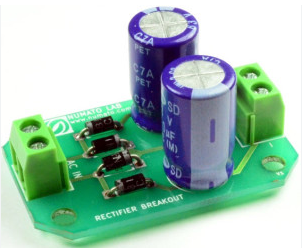
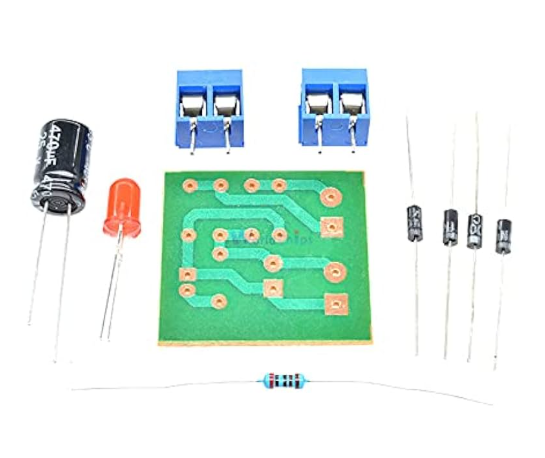
Diode:Four semiconductor diodes form the core of the circuit.Diodes are chosen for their unidirectional conductivity,which allows current to flow in only one direction,a critical feature for converting AC to DC.Typically, silicon diodes are used for their low forward voltage drop and high reliability.
AC Input Terminal:This terminal is connected to the AC power source (such as household AC power or industrial AC power), which provides the alternating current that needs to be rectified.
DC Output Terminal:Located at the output end of the circuit, it delivers the converted direct current to the load for power supply.
Filter Capacitor (Optional):Although not a mandatory component of the basic full bridge rectifier,a filter capacitor is often connected in parallel at the DC output terminal.Its function is to smooth the pulsating DC output,reducing voltage fluctuations and providing a more stable DC voltage.
2.3Working principle
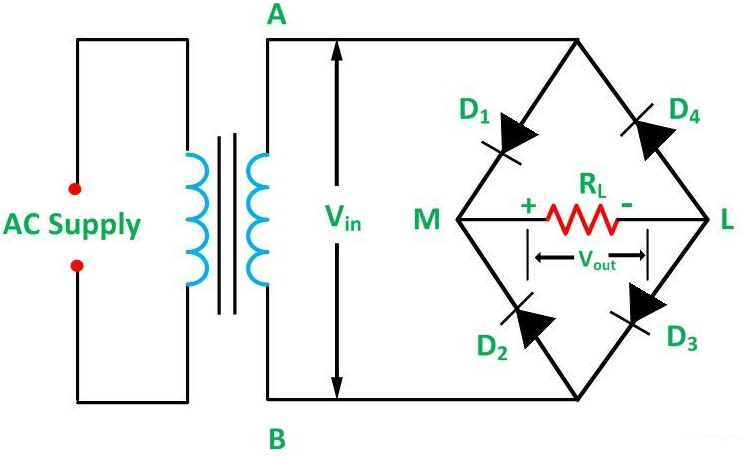
Positive Half-Cycle of AC Input:When the AC input is in the positive half-cycle, the upper left and lower right diodes in the bridge circuit are forward-biased and conduct, while the upper right and lower left diodes are reverse-biased and cut off.The current flows from the positive terminal of the AC input, through the conducting upper left diode, then to the load,and finally back to the negative terminal of the AC input via the conducting lower right diode,forming a complete current loop and generating a positive voltage drop across the load.
Negative Half-Cycle of AC Input:When the AC input enters the negative half-cycle, the polarity of the input voltage reverses. At this point, the upper right and lower left diodes become forward-biased and conduct, while the upper left and lower right diodes are reverse-biased and stop conducting. The current flows from the negative terminal of the AC input (now acting as the positive side in this half-cycle), through the upper right diode, then to the load, and back to the positive terminal of the AC input (now acting as the negative side) via the lower left diode.
High Rectification Efficiency:Compared to half-wave rectifiers, full bridge rectifiers utilize both the positive and negative half-cycles of the AC input, avoiding the waste of half of the AC energy. This results in a rectification efficiency of up to approximately 81.2% (excluding diode voltage drops), significantly higher than the 40.6% efficiency of half-wave rectifiers, making it more energy-efficient.
Stable DC Output:The output DC voltage of a full bridge rectifier has a higher ripple frequency (twice the frequency of the AC input).This higher frequency makes it easier to smooth the output voltage using a filter capacitor or other filtering components, reducing voltage pulsations and providing a more stable DC power supply for the load, which is beneficial for the normal operation of sensitive electronic devices.
Wide Voltage Adaptability:It can be designed to work with different AC input voltage ranges by adjusting the specifications of the diodes and matching with appropriate transformers.This wide adaptability allows it to be applied in various power supply scenarios, from small electronic devices to large industrial equipment.
Simple Structure and High Reliability:The core components of a full bridge rectifier are only four diodes and a few auxiliary terminals, with a relatively simple circuit structure.Fewer components mean lower failure rates, and diodes themselves are highly reliable electronic components with a long service life,ensuring the stable operation of the rectifier circuit for an extended period.
Low Cost:The main components are low-cost and easily available in the market.The simple circuit design also reduces the manufacturing and maintenance costs of the rectifier.This cost advantage makes full bridge rectifiers widely used in mass-produced electronic products, such as power adapters and household appliances.
Power Adapters and Chargers:It is a key component in power adapters for laptops, mobile phones, tablets, and other electronic devices, as well as in battery chargers for electric tools and electric vehicles.It converts the AC power from the mains into DC power to charge the battery or directly power the device, ensuring stable power supply.
Household Appliances:Many household appliances, such as televisions, refrigerators, air conditioners, and washing machines,require DC power to drive their internal control circuits,motors,or other components.Full bridge rectifiers are used in their power supply units to convert AC mains power into the required DC voltage, enabling the normal operation of these appliances.
Industrial Power Systems:In industrial settings, full bridge rectifiers are widely used in variable frequency drives (VFDs) for motors, uninterruptible power supplies (UPS), and industrial control systems. For example, in VFDs, they convert AC power into DC power, which is then inverted into variable-frequency AC power to control the speed of motors, improving energy efficiency and motor control precision.
Renewable Energy Systems:In solar power generation and wind power generation systems, the electrical energy generated by solar panels or wind turbines is often AC .Full bridge rectifiers are used to convert this AC energy into DC energy, which can be stored in batteries or inverted into grid-compatible AC power for feeding into the power grid, facilitating the utilization of renewable energy.
Medical Equipment:Precision medical equipment,such as medical monitors, ultrasound machines,and small medical devices, requires a stable and reliable DC power supply to ensure accurate operation and measurement.Full bridge rectifiers, with their stable output and high reliability,are used in the power supply modules of these medical devices to provide clean DC power, meeting the strict requirements of medical applications.
In summary, the full bridge rectifier is a vital electronic component that efficiently converts AC to DC, characterized by high rectification efficiency, stable output, simple structure, low cost, and wide adaptability. As a fundamental part of power supply technology, it plays an indispensable role in ensuring the stable and efficient operation of various electronic and electrical systems.
Industry Information